



 Ανεβάστε φωτογραφίες από
Γήπεδο Ποδοσφαίρου και μοιραστείτε τις μαζί μας!
Ανεβάστε φωτογραφίες από
Γήπεδο Ποδοσφαίρου και μοιραστείτε τις μαζί μας!


Νομός: Ηρακλείου
 Διεύθυνση:
 Τηλέφωνο:




Γήπεδο Ποδοσφαίρου
Μέρη κοντινά με Γήπεδο Ποδοσφαίρου


Βρίσκεται ΝΔ της Κοινότητας Μάραθου στην τοποθεσία Αρκαλοκέφαλο.
Η είσοδος είναι πλάτους 2,10 και ύψους 1 μέτρο, το συνολικό μήκος των αιθουσών του είναι 153 μέτρα. Μέσα στο σπήλαιο έχουν βρεθεί όστρακα ρωμαϊκά, βυζαντινά και μεσαιωνικά, επίσης υπάρχουν αρκετοί σταλακτίτες και σταλαγμίτες. Κατά την τουρκοκρατία χρησίμευε σαν καταφύγιο των χριστιανών.
http://www.tylisos.gr/

The entrance of the cave is 1,85m. high and 1,20 metres wide. The hall is big (15,50m.x30m. with a height of 7 metres), with impressive stalactites and stalagmites. The one who enters the cave sees right away in the centre, two pillars of stalagmites which leave a little empty space between them so that a human being can hardly pass through as well as other large complexes of stalagmites.
The cave is inaccessible. In order someone to get inside needs a rope because in the mouth there is an abrupt downshift of 2 metres. It is a gradual chasm with a total tunnel length of 430 metres. There is a lake inside, from what French speleologists say who have explored Spiliara, and it takes special equipment for its exploration. It is the second cave in length in Malevizi Province.
In Spiliara cave the residents of Astiraki were hiding during the 2nd World War, when the Germans were bombing.

Μόλις 25 χιλιόμετρα δυτικά του Ηρακλείου βρίσκεται το φαράγγι του Σαντορινιού. Ένα όχι αρκετά μεγάλο φαράγγι το οποίο δεν έχει αξιοποιηθεί ιδιαίτερα, με αρκετά πυκνή βλάστηση και αρκετές λίμνες που κάνουν την πρόσβαση αρκετά δύσκολη.
Μπαίνοντας συναντάμε έναν αρκετά παλιό νερόμυλο και συνεχίζουμε ώστε να αντικρίσουμε την λίμνη Αζιλόκαμπο. Μετά από αρκετό ψάξιμο μπορεί να διαπιστώσει κανείς ότι μπορεί να συνεχίσει, αφού μοιάζει να έχει φτάσει το τέλος της διαδρομής και να συναντήσει έναν καταρράκτη που ονομάζεται Σαντορινιός του οποίου τα νερά χύνονται σε μία μικρή λίμνη.
Πραγματικά ένα αρκετά μαγικό τοπίο το οποίο κρύβει αρκετούς φυσικούς θησαυρούς.


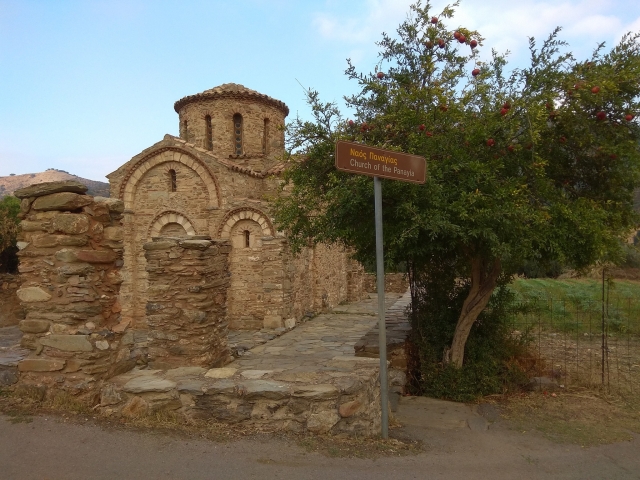

Ο μικρός ναός των Εισοδίων της Θεοτόκου στο Φόδελε καταλαμβάνει το ανατολικό ήμισυ μιας προγενέστερης χρονολογικά τρίκλιτης βασιλικής. Είναι ένας σταυροειδής εγγεγραμμένος με τρούλο χωρίς νάρθηκα ναός. Στην τοιχοδομία του έχει ενσωματώσει σπόλια από τον αρχαιότερο ναό.
Ο ναός της Παναγίας σώζει δυο στρώματα τοιχογραφικού διακόσμου. Το αρχαιότερο στρώμα εντοπίζεται στα δυτικά γωνιακά διαμερίσματα και χρονολογείται στον 11ο αι. Στο βόρειο τοίχο αναπτύσσεται σε πυκνή παράταξη σειρά ολόσωμων αγίων και μαρτύρων με τους αγίους Κωνσταντίνο και Ελένη. Στο νότιο τοίχο εικονίζεται η Δέηση και στους πεσσούς ολόσωμοι στρατιωτικοί άγιοι. Στα εσωρράχια των τόξων του βορείου και νοτίου διαμερίσματος αντίστοιχα διευθετούνται από μια πεντάδα μαρτύρων που συνεορτάζονται στις 25 Νοεμβρίου και 13 Δεκεμβρίου. Η ποιότητα της ζωγραφικής, ο κλασικιστικός της χαρακτήρας με τις ωραίες μορφές των οποίων τα χαρακτηριστικά αποδίδονται με πλατιές ελεύθερες πινελιές και χαμηλό ανάγλυφο, οι μορφές των αγίων και ο τύπος της μορφής του Χριστού από την παράσταση της Δέησης μαρτυρούν την άμεση εξάρτηση της ζωγραφικής από τα καλλιτεχνικά κέντρα της Κωνσταντινούπολης, η δράση των οποίων τεκμηριώνεται μέσα από έργα που βρίσκονται στην άμεση σφαίρα επιρροής της πρωτεύουσας (Νέα Μονή Χίου, Επισκοπή Ευρυτανίας, εικόνα Δέησης της Λαύρας).
Οι τοιχογραφίες της νότιας κεραίας του σταυρού ανήκουν στο ζωγραφικό στρώμα που χρονολογείται σύμφωνα με κτητορική επιγραφή στα 1323. Παριστάνονται η Υπαπαντή καθώς και σκηνές από το Βίο της Θεοτόκου. Οι παραστάσεις χαρακτηρίζονται από έντονο συντηρητισμό, καθώς συνδυάζουν τη χρήση των μαλακών τονικών διαβαθμίσεων της παλαιολόγειας τέχνης στο πλάσιμο των όγκων με τη γραμμική τεχνική των προηγούμενων δεκαετιών στην απόδοση των χαρακτηριστικών και των κλειστών περιγραμμάτων των μορφών. Έτσι η ομάδα αυτή των τοιχογραφιών εκπροσωπεί την ντόπια καλλιτεχνική παράδοση, λαϊκού χαρακτήρα, που ωστόσο δεν μπορεί να μείνει ανεπηρέαστη από την ανανεωτική διείσδυση της παλαιολόγειας τέχνης.


It had the type of a fortress and is surrounded by wall. Next to the gate there is a built-in, marble inscription with the year 1977 (the establishment of the monastery is being located a few years before) and on the lintel there is an inscription with the year 1861 (that was when the great renovation was being made, by Neofytos Pediotis).
Outside the monastery, 100 meters west of the entrance, an arched water tank is being saved (it was built in 1866 as the built-in inscription indicates), with a very old fountain in front of it. The monastery of Agios Panteleimonas always had its gates open to the rebels and that’s why has repeatedly suffered destructions from the Turks.
In 1824, it was plundered and ruined by the Turk-Egyptians of Husein. At the second year of the revolution of 1866, it was burnt down by the men of Resit Efenti. Yet, in the biggest destruction of the monastery the Turks had no interference. In 1972, the abbey and all the cells of the monks were pulled down, except of two. It is said that the reason that prescribed this act was the… expectation that a treasure would be found, which was believed to be buried in the foundation of the monastery. Nowadays in Agios Panteleimonas lives only one monk.Contact Number: +30 28 10 52 13 41


Kamariotis is a mountainous village west of Tylisos Village. It is built in a beautiful location, at a height of 620 meters and in a distance only 25 minutes (15, 5 km) from Tylisos and 27 km far from Heraklion City. The last few years the residents return for permanent installation, they recondition the old stone houses and the village is coming back to life. At a central point, there is the three-kliti (“klitos” is the aisle that divides the Christian church in two parts, or more if there are more than one klitos) arch-covered church of Agios Georgios, built in the 16th century. On the lintel of the west gate there is the lion of Agios Markos and on the bow of the central klitos the two-headed eagle, the blazon of the Byzantine family of the Kalergis.The two-kliti Byzantine church of Virgin Mary, which is located at the edge of the village, has remarkable wall paintings and a tomb inside it. In the square of the village there is a Turkish fountain and next to it built barbeques and bakers. It is there, where the feast of Agios Georgios takes place in April and that of Virgin Mary on the 15th of August, with treat from the cultural association. In November, at the same place, the boiling of raki is being made, with appetizers. Here, there is a tavern with traditional food, where the visitor can enjoy the local cuisine.At the western exit of Kamariotis there is a dirt-road that leads to Tripiti, where there is an impressive natural monument: huge rocks create “labyrinths” and compose strange shapes.For a short walk, there is a path offered that goes through the oak-forest, a wonderful forest of oaks, locust trees, holms and the beautiful churches of Kamariotis, which extends almost to the village of Aidonochori. According to a local legend, the church bell of Agios Georgios had a golden bullet and a tremendous sound that could be heard as far as Chania. When the Turks came to the island, the residents hid the bell, probably in a hollow of the rock above which the church is built, and no-one ever saw it again… In 2004 renovating works of the Agios Georgios’s church started and the hopes that the bell with the golden bullet would be found were reanimated.Residents’ main occupation is agriculture.Points of Interest1. Places of InterestSquare – Venetian FountainChurches: Agios Georgios of 16th century, a two aisled Byzantine Church of Saint Mary2. Natural Environment "Tripiti” area with impressive natural sculptures in rocks.The whole region “Kremasto-Achlada-Armi-Kapsida” can be characterised as an area of special interest due to the opulent vegetation and due to the Forest with oaks, locust trees and pine trees, where there is an old watermill. Generally, the total lanscape with view towards Psiloritis Mountain is characterised as an area of special natural beauty.3. Useful InformationCultural Association - EventsFestival of Agios Georgios on 23rd of AprilFestival of Virgin Mary on 15th of AugustEvents on Good FridayFestival of Raki on November4. Accomodation – Gastronomy – Recreation AreasTraditional Tavern, Cultural Association’s cafeteria in the square, Cultural association’s rooms to let.


 Σύνδεση με
Facebook
Σύνδεση με
Facebook