



 Upload your photos for Maza Gorge and share them with us!
 Press here.


Prefecture: Lassithi
 Address:
Adravasti Sitia
Address:
Adravasti Sitia  Telephone:




Maza Gorge
Maza gorge starts in Karydi and ends just outside Adravasti. It is long with impressive landforms in its interior, however the trail is only for experienced canyoners. In the past it was the main road connecting various hamlets.
Places near Maza Gorge


Magas (Brysidi)
A small village whose inhabitants gradually abandoned it around 1850 and went down to Palaikastro seeking more fertile fields. A few traditional stone houses have been preserved, as luckily some descendants return and renovate them with care and respect, to blend in with the rocky landscape.
Mitato (the word means «cheese dairy» in the Cretan dialect) is the central village of a community of five small villages, the other four being Chonos, Xerolimni, Krioneri or Misiryou (perhaps derived from the Latin missir: gentleman or lord, or Misr: Egypt) and Vrisidio or Magassa. The road to these villages passes through Roussa Ekklisia. Prehistoric tombs were found at Langos in the Mitato district, and on the summit of the hill Modi (539m) which also belongs to the community. Mitato Mitato Mitato An open-air peak sanctuary was excavated in 1971. This had not been plundered and many votive offerings were found, including a lot of bronze votive knives. Traces of a building were also located. Nowadays, because of the high mountain climate (590m above see level), fewer and fewer people live permanently in these villages; most of the former inhabitants spend the greater part of the year in Palekastro or Sitia
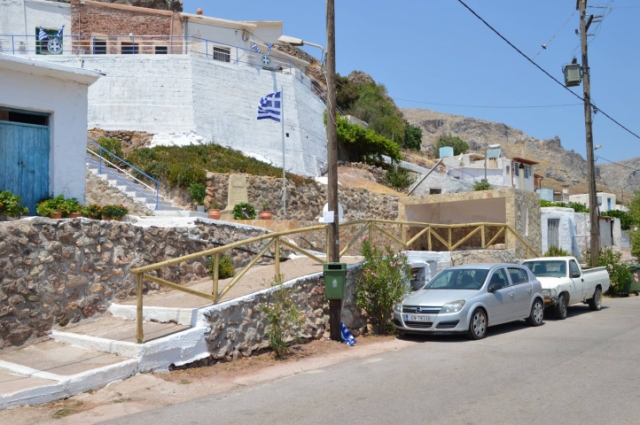
This village belongs to the Itanos Municipality. The origin of the name is unknown, perhaps it is derived from a family name. It is not mentioned in the 1583 census, but it is believed to have been razed with other villages during Turkish pirate raids in 1471 AD and later reestablished after the 16th century.
Το the west of the settlement is the hill of Endichtis (560m) which was believed to have been the site of a peak sanctuary. Excavations in 1972 however proved that this could not have been so. Various things such as loom weights, a whetstone and clay spindle whorls were collected, but not one single figurine, which seems to exclude the possibility of this spot having been a shrine. So it must be regarded rather as a simple habitation.
Adravasti is 36 km from Sitia, 2 km from Zakros and 16 from Palekastro.From the book "Sitia", N. Papadakis, Archaeologist, 1983

Between the hamlets of Magassa and Mitato and in certain segments of the country road that connects them, portions of the old cobbled road that used to connect the two hamlets is still preserved.




 Login with
Facebook
Login with
Facebook