



 Upload your photos for Agii Eftyhiani and share them with us!
 Press here.


 Address:
 Telephone:




Places near Agii Eftyhiani


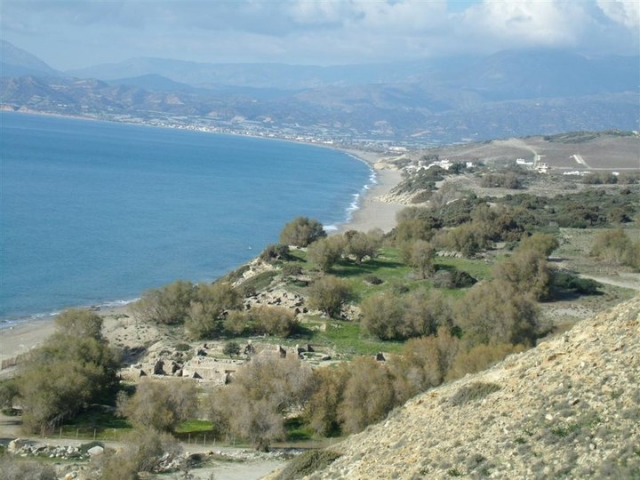

At Kommos, above the famous beach in the south of the prefecture of Heraklion, there is the archaeological site of the Minoan city of Komos. Kommos in Minoan Crete was one of the two ports of the Minoan palace of Phaistos. Matala was the other one.
Excavations of the archaeological site began for the first time in 1976 by a group of Canadian archaeologists, but the existence of Kommos and its connection to the palace of Phaistos was known by Sir Arthur Evans. The finds include the harbor settlement, and public buildings such as shipyards, warehouses, prytaneion, temple and an amphitheater building. One of the most important finds are the ancient olive oil presses, which reveal how developed was the cultivation of olive trees in Minoan Crete.
The archaeological site is not accessible but you can admire the building findings outside the fenced area which is accessible from the road leading to Kommos beach.

The apartments "Acropol" are located in Pitsidia, one of the most beautiful villages of south Crete.
Pitsidia finds itself a couple of kilometres from Matala and Phaistos archaeological site, and about 75 kilometres from Heraklion town.


The name ‘Mesara’ comes from the Greek for ‘between mountains.’ Mesos – between, oros – mountains, which becomes Mesaoria or the modern word, Mesara. In the north are the southern foothills of the Psiloritis or Ida mountain range and in the south are the Asterousian mountains between the Mesara and the Libyan Sea. The coastline of the Mesara faces west almost from Agia Galini in the north to Matala in the south. Between the two is one of the most perfect and extensive beaches in Crete, mostly with hardly a soul to be seen.
Two rivers flow through the Mesara and both have their source near to the village of Asimi. From there they flow in opposite directions. Geropotamos, known in ancient times as Lethaios, flows westwards to the sea and out into the Gulf of Mesara. Anapodaris, ancient name Katarhaktes, flows into the bay of Derma, east of the village of Tsoutsouros.
Here in the Mesara in ancient times, civilisation grew from Neolithic (5th Century BC) to the modern day. During the Minoan Prepalatial period growth was amazing (4th & 3rd centuries BC) where huge leaps forward were taken in architecture, pottery, the incredible circular tholos tombs, Agios Onoufrios and Kamares ware, countless figurines, seals and jewelry were produced.
In the first Palace period we see the palace at Festos being built (1900 – 1700 BC). The second Palace period was centered around the later palace at Festos, the palatial buildings at Agia Triada and at the port of Kommos just north of Matala near Pitsidia (1700 – 1300 BC).
Later the came Gortyn, the magnificent city that dominated the Mesara for sixteen centuries, from 800BC to 800AD. Gortyn is situated just west of Agioi Deka and covered a diameter of ten kilometres. It is said that in its greatest years over 80,000 people lived in Gortyn and in Roman times it became not only the capital of Crete but the Capital of Cyrene as well (North Africa).
There is still a plane tree in the ruins of Gortyn that keeps its leaves all year. Under that tree Zeus made love to Europa and the children that they produced were Minos, the king at Knossos and his brother Rhadamantys, King of Festos.

At the edge of the western point of mount Asterousia lies Listaros settlement, the last passage to the mountain and the south coast. Records reveal that the settlement existed since 1577 and was part of Kainouriou province. The statistics of the Barozzi code refer to it as “Listaro”. Despite its long history, settlement continues to “live” although its inhabitants unfortunately gradually abandon it.
Listaros is approximately 200 metes above sea level in this south western area of the prefecture of Heraklio. At this pleasant altitude, just above the intense heat down at sea level, but low enough to enjoy the benefits of the very mild winters on the south side of Crete. Add to this; views over the lower end of the might Messara Plain, across the bay to Agia Galini and out to the Paximadia Islands. All this with a backdrop of the Psiloritis mountains, and you have a truly beautiful part of Crete.
In an island full of climatological and environmental diversities, the area of the Messara plain has a unique character and a lot of diversities to offer itself. It is the largest plain of Crete that extends to the central and southern region of Heraklion County.
It is surrounded from the north by mount Idi (Psiloritis), from east by mount Dikti (Lassithiotika Ori) and from south by mount Asterousia that meet with the Libyan Sea.
While the land of the Messara plain is one of the most fertile ones found on the island, the landscape changes dramatically as the traveler reaches mount Asterousia. A few small ports are the only ones that disrupt the deserted scenery. Monkhood blossomed here from the 7th till the 15th century, something that can be easily detected by the number of monasteries and sketes found in the near gorges and canyons.
Some of the finest examples are the monasteries of Odigitrias, Koudouma and Apezanon, the sketes of Saint Nikita, Martsalo and Agiofarago gorge.DISTANCE FROM LISTAROS:65 klms from the airport and a few less from the port of Heraklion.12 klms from the town of Moires to Matala and Siva0,5 klm from the Komos beach.4,5 klms from Monastery of Odigitrias and another 5-6 klms for the beaches Kaloi Limenes, Agiofarago, Martsalo, Vathi.
The village of Pitsidia is located 65 km southwest of Iraklion at an altitude of 80 m a.s.l, just before the magnificent bay of Messara and 2km far from the famous Kommo beach. The village with aproximately 700 inhabitants is the seat of the Pitsidia-Matala community. Pitsidia is the oldest village of the area and is refered (by S. Spanakis) that it was the place where the s oldiers of Nikiforos Fokas, commander of the Byzantine army, settled. The army, famous for its bravery, came from Pisidia of the south Asia Minor, and this is probably the origin of the name Pitsidia. The road from Iraklion is fairly good and passes through the Messara valley. Regular public transportation is available for visiting Pitsidia-Matala. The climate is temperate and it promotes longevity and well-being, as the inhabitants of the village are famous for their longevity.Pitsidia is a quiet village, with a long tradition of hospitality. The spotlessly clean accommodation units, the taverns with their traditional cuisine, the cafes with their aroma of Greek coffee, as well as the cosmopolitan ambiance of the area during the summer months, warranty a memorable stay to all visitors. Visitors are always welcomed at Pitsidia.For more information about Pitsidia, you are invited to visit , or call, the offices of the Community Enterprise of Pitsidia (tel:+30-2892-45340/45720). Pitsidia Pitsidia: Kommo Beach Pitsidia The surrounding landscape is of exceptional natural beauty with archaeological and historical sites which attract a large number of tourists each year. Within the Pitsidia community, 4 km to the southwest, lies the renowned resort of Matala. At a distance of 1500 m. lies the long sandy beach of Kommos and the antiquities of Kommos. Pitsidia Pitsidia Also, the village of Pitsidia can be the starting point for outing and excursions to the archaeological sites in the broader area. Some of the most interesting sites are the ancient mansion of Pitsidia, the archaeological sites of Laggou, Phaistos, Agia Triada and Gortys, the monastery of Odigitria, the gorge of "Agiofarago".

Life revolves around the square where you can enjoy the company of local people who always make you feel welcome. Sivas has a special feel about it, which is out of the fact that many people return year after year.
Near the village the archaeologists unearthed circular tombs of the pre-palace period (2600-2000 B.C.). In 1958 a full collection of early Hellenistic coins were found. However, looters stole most of these and only 36 coins were found and are currently on display at the Archaeological Museum of Iraklion.In the middle by the village the meanwhile completely asphalted road leads up to the militaryful Odigitria Monastery, highly above in the mountains.During summer months the village square in front of the church, takes centre stage of daily life. Here you will find some Kafenia (Cafés), the butcher, a small supermarket, herb and handcraft shops, a pottery and also a silversmith. While the children are swinging and sliding on the playground in the shade of the large trees, you can find everything for the daily need in the small shops around the place.
Matala beach is one of the most beautiful beaches in Crete, renowned all over the world due to its uniqueness and beauty. Matala (and Kommos beach) used to be the port of Gortys and Phaistos. It was a tiny fishing town near Pitsidia, that developed to be one of the most modern and scenic holiday resorts in the island.
Matala became known to the entire world during the 60s when hippies from every corner of the world were gathering there enjoying the lovely sea and the freedom offered grandly by this gorgeous inlet.
Artificial caves carved in the north part of the shores, sapphire blue waters and endless sandy beach is what you can expect when visiting Matala. The towering rocks, formed by the caves, are overlooking the waters and attract numerous tourists who choose to dive in the sea or simply lay and enjoy the sun.
Joni Mitchell wrote a song for her experience in Matala Beach along with the Hippie commune; the name of the song is Carey. The Flower Children, as they were called, didn’t manage to realise their conference as intended, however they managed to enjoy the beauty of the area and the breathtaking views to the Bay.
Today Matala Beach is a lovely tourist destination featuring resorts, hotels and numerous restaurants featuring the infamous Cretan and Greek Cuisine. It is situated approximately 70km from the city of Heraklion at the Messara Bay.


 Login with
Facebook
Login with
Facebook