



 Upload your photos for Football Stadium and share them with us!
 Press here.


 Address:
 Telephone:




Places near Football Stadium


It is located on the south west of Marathos community (Old national road Heraklion - Rethymno), 9 km after the crossroad for Tylisos village, in Arkalokefalo location.
The entrance is 2,10m. wide and 1 meter high and the total leength of its halls is 153 metres.
Inside the cave there have been found conches, roman, Byzantine and medieval ones, as well as many stalactites and stalagmites. During the Turkish domination the cave was used as a shelter for the Christians.
http://www.tylisos.gr/

The entrance of the cave is 1,85m. high and 1,20 metres wide. The hall is big (15,50m.x30m. with a height of 7 metres), with impressive stalactites and stalagmites. The one who enters the cave sees right away in the centre, two pillars of stalagmites which leave a little empty space between them so that a human being can hardly pass through as well as other large complexes of stalagmites.
The cave is inaccessible. In order someone to get inside needs a rope because in the mouth there is an abrupt downshift of 2 metres. It is a gradual chasm with a total tunnel length of 430 metres. There is a lake inside, from what French speleologists say who have explored Spiliara, and it takes special equipment for its exploration. It is the second cave in length in Malevizi Province.
In Spiliara cave the residents of Astiraki were hiding during the 2nd World War, when the Germans were bombing.

Just 25 kilometers west of Heraklion there is the Santorinios gorge. Its a small gorge which has not been exploited with fairly dense vegetation and several lakes that make its access very difficult.
In the entrance there is a pretty old watermill and in a few meters we face up the lake Azilokampo. After some searching you will find that you can continue, as seems you have reached the end of the gorge and meet a waterfall called Santorinios whose waters fall into a small lake.
It's a magical landscape which hides many natural treasures.


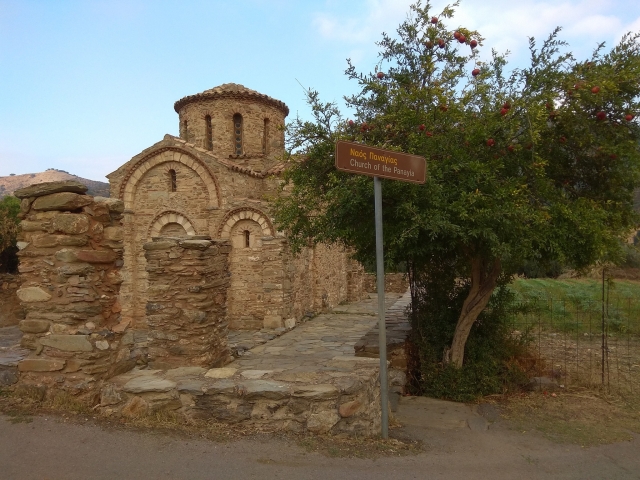

The church of Panagia in Fodele is dedicated to the Presentation of Virgin Mary and is almost 1 km northwest of the village on the road leading to the museum of El Greco.
The church is a Byzantine building of the 11th century, which has been built up on the half of an older temple of the 6th century which existed on the spot and was an early Christian basilica. The interior of the church has two layers of frescoes, the oldest dating back to the 11th century and the youngest according to the inscription in 1323. Architectural the temple is cruciform with a dome, without narthex, although it is based in Helladic architecture it has several structural and decorative elements that refer to the Constantinople architecture.


It had the type of a fortress and is surrounded by wall. Next to the gate there is a built-in, marble inscription with the year 1977 (the establishment of the monastery is being located a few years before) and on the lintel there is an inscription with the year 1861 (that was when the great renovation was being made, by Neofytos Pediotis).
Outside the monastery, 100 meters west of the entrance, an arched water tank is being saved (it was built in 1866 as the built-in inscription indicates), with a very old fountain in front of it. The monastery of Agios Panteleimonas always had its gates open to the rebels and that’s why has repeatedly suffered destructions from the Turks.
In 1824, it was plundered and ruined by the Turk-Egyptians of Husein. At the second year of the revolution of 1866, it was burnt down by the men of Resit Efenti. Yet, in the biggest destruction of the monastery the Turks had no interference. In 1972, the abbey and all the cells of the monks were pulled down, except of two. It is said that the reason that prescribed this act was the… expectation that a treasure would be found, which was believed to be buried in the foundation of the monastery. Nowadays in Agios Panteleimonas lives only one monk.Contact Number: +30 28 10 52 13 41


Kamariotis is a mountainous village west of Tylisos Village. It is built in a beautiful location, at a height of 620 meters and in a distance only 25 minutes (15, 5 km) from Tylisos and 27 km far from Heraklion City. The last few years the residents return for permanent installation, they recondition the old stone houses and the village is coming back to life. At a central point, there is the three-kliti (“klitos” is the aisle that divides the Christian church in two parts, or more if there are more than one klitos) arch-covered church of Agios Georgios, built in the 16th century. On the lintel of the west gate there is the lion of Agios Markos and on the bow of the central klitos the two-headed eagle, the blazon of the Byzantine family of the Kalergis.The two-kliti Byzantine church of Virgin Mary, which is located at the edge of the village, has remarkable wall paintings and a tomb inside it. In the square of the village there is a Turkish fountain and next to it built barbeques and bakers. It is there, where the feast of Agios Georgios takes place in April and that of Virgin Mary on the 15th of August, with treat from the cultural association. In November, at the same place, the boiling of raki is being made, with appetizers. Here, there is a tavern with traditional food, where the visitor can enjoy the local cuisine.At the western exit of Kamariotis there is a dirt-road that leads to Tripiti, where there is an impressive natural monument: huge rocks create “labyrinths” and compose strange shapes.For a short walk, there is a path offered that goes through the oak-forest, a wonderful forest of oaks, locust trees, holms and the beautiful churches of Kamariotis, which extends almost to the village of Aidonochori. According to a local legend, the church bell of Agios Georgios had a golden bullet and a tremendous sound that could be heard as far as Chania. When the Turks came to the island, the residents hid the bell, probably in a hollow of the rock above which the church is built, and no-one ever saw it again… In 2004 renovating works of the Agios Georgios’s church started and the hopes that the bell with the golden bullet would be found were reanimated.Residents’ main occupation is agriculture.Points of Interest1. Places of InterestSquare – Venetian FountainChurches: Agios Georgios of 16th century, a two aisled Byzantine Church of Saint Mary2. Natural Environment "Tripiti” area with impressive natural sculptures in rocks.The whole region “Kremasto-Achlada-Armi-Kapsida” can be characterised as an area of special interest due to the opulent vegetation and due to the Forest with oaks, locust trees and pine trees, where there is an old watermill. Generally, the total lanscape with view towards Psiloritis Mountain is characterised as an area of special natural beauty.3. Useful InformationCultural Association - EventsFestival of Agios Georgios on 23rd of AprilFestival of Virgin Mary on 15th of AugustEvents on Good FridayFestival of Raki on November4. Accomodation – Gastronomy – Recreation AreasTraditional Tavern, Cultural Association’s cafeteria in the square, Cultural association’s rooms to let.


 Login with
Facebook
Login with
Facebook