



 Upload your photos for ΚΨΥ ΧΑΝΙΩΝ and share them with us!
 Press here.


 Address:
 Telephone:




ΚΨΥ ΧΑΝΙΩΝ
ΚΨΥ ΧΑΝΙΩΝ
Places near ΚΨΥ ΧΑΝΙΩΝ


East of Splatzia Square of the old city of Chania is located the church of Agios Nikolaos, which was built before 1320, during the Venetian Period, as monastery of Dominican Order. During the Venetian period it constituted the most important church of the city.
It was elegant and big in capacity, with wide arches in the interior. After the predominance of Turks in Chania the temple was turned into mosque and was named Hiougkar Tzamisi (mosque of the Emperor), in honour of the sultan of Ottoman Empire, Imbraim.
Its importance is highlighted by the existence of two- instead of one- balconies on the minaret. In 1928, after being seized by the Christians orthodoxe, the mosque was turned into a christian church and has been dedicated to Agios Nikolaos.


The rampart Sabbionara still preserves its Turkish name "koum - kapi (Kum Kapisi = the Gate of the Sand), is located on the northeast corner of the Venetian walls and is completely constructed in the sea. On the front of the rampart, the circular Venetian emblem of the lion of Agios Marcos is still preserved. It is the only preserved gate today and its external side had been modified during the Turkish period.
It is the only preserved gate today and its external side had been modified during the Turkish period. The port of Chania cannot be used by modern ships because of the shallow water, which contributed in preserving its old character, maintaining the signs of its conquerors till today.


The clock tower of the city is located on the north-east part of the Municipal Garden. Its construction started in 1924 and ended in 1927 and constitutes one of the most remarkable buildings of the City of Chania.

The church of Agios Nikolaos, located in Splantzia Square, was built before 1320, during the Venetian period, as a monastery of Dominican Order. After the dominance of Turks in Chania in 1645, the church was transformed into a mosque and was given the name Hiougkar Tzamisi (the Emperor’s mosque), in honour of sultan of the Ottoman Empire, Imbraim.
The sword of the Turk dervish, who was the first one that entered in the city, was considered to be blessed and wonder-working, and was reserved there. Its importance is highlighted by the existence of two- instead of one- balconies on the minaret on the southwest corner of the temple. The morphological elements of the minaret are of great interest, as they follow the Venetian tradition.

Along the famous waterfront there are built numerous cafes, bars and a few traditional tavernas with wonderful views to the sea and a part of the Venetian Walls. The locals usually prefer this part of the waterfront to have a coffee in the evening or a first drink during the night.
The history of Kum Kapi starts during the last years of the Turkish occupation when the Arabs grew "Halikoutes", a small village, near a sandy beach and next to the Venetian fortifications. This district was called in Turkish "Kum Kapisi" (meaning Gate of the Sand) because of the Venetian Gate built there.
If you want to have a coffee in the Kum Kapi waterfront you can try the following cafe-bars; Elliniko at the start, Thema at the centre, Il Nostro at the end, and the rock-cafe Other Side near the end. There are also many choices for food like the first two restaurants at the start of the waterfront (O Aswtos Yios, Diachroniko) or the restaurant next to the Thema.
The area of Kum Kapi is quite near the old Venetian Town so that you can walk to get from the one place to the other. While walking , if you follow the seafront, you will meet more seafood restaurants (try the Dinos Restaurant) and cafes (try the Dio Lux).


The fatherly house of Eleftherios Venizelos in Halepa of Chania, which constituted his house for more than thirty years, from 1880 to 1910 and later for short periods from 1927 to 1935, today constitutes a Museum under the responsibility of “National Institution of Researches and Studies El. Venizelos”, in which it has been granted by the Greek state.
The collection of the Museum consists of the complete household effects of the ethnarch, which he personally selected, from works of art, part of his library, his personal objects and from the collection of objects and records of Institution, relative to the period, the action and the personality of Venizelos. Characteristic is also that all the areas of the residence have maintained their authentic form until today, the one that they had during the period that El. Benizelos lived at the house.
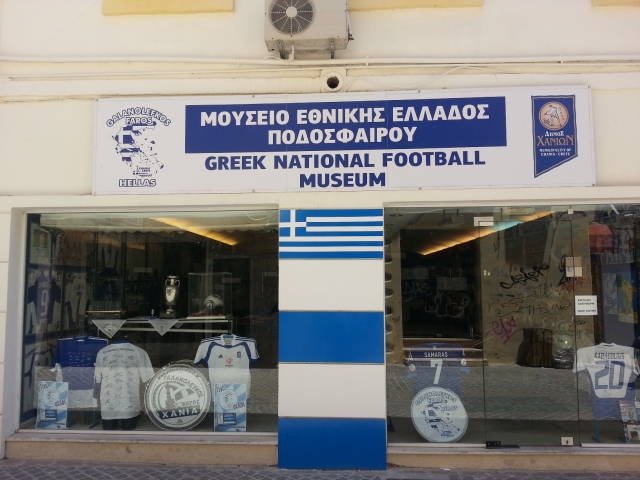
The Museum of the Greek National team is unique in Greece and one of the few that exist worldwide at national team level. Inside this museum, the history of the Greek National footballteam comes to life again and the visitor can learn it through the hundreds of objects and shirts of the current National team, as well as of previous teams.
Some of the most popular objects that somebody can see in the Museum are the shirts of the International Greek Team from historical games and more, the replica of the Cup from the European Championship 2004, the ticket of the final game Greece-Portugal, the ball from the game Greece-Nigeria 2-1, the unique victory of the National Team in the World Cup etc…

The War Museum of Athens founded a department in 1995, in the framework of a cooperative program between the two cities and museums.
The aim of the Museum is the collection, protection, conservation and exhibition of war artifacts and other items, mainly from the period 1821-1940 that covers most of the national wars and revolutions, including the participation of Cretan soldiers in the Macedonian Wars (1903 - 1922) in the Balkan Wars (1912-13), the Asia Minor Campaign (1919-1922), in the World Wars I and II and during the German occupation (1941-1945).
Tel: (2821) 0 44156
The Residence of Baroness Von Schwartz in Chania: The exquisitely designed residence of the Baroness Von Schwartz is one of the finest samples of the neoclassical architectural style of Chania. It was built in 1860 and from 1865 till the end of the Turkish occupation, it was a social and philanthropic centre. This magnificent residence is located in the suburb of Chalepa and has turned into a prominent cultural landmark of Chania Town. The sheer elegance of this residence immediately draws the attention of visitors. The marble steps and the porch are truly fine pieces of craftsmanship. The residence is today uninhabited but still well-preserved by the local government.
Maritime Museum of Crete
Exhibition of Ancient and Traditional Naval Architecture
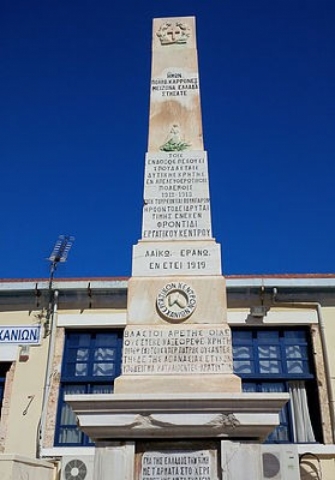
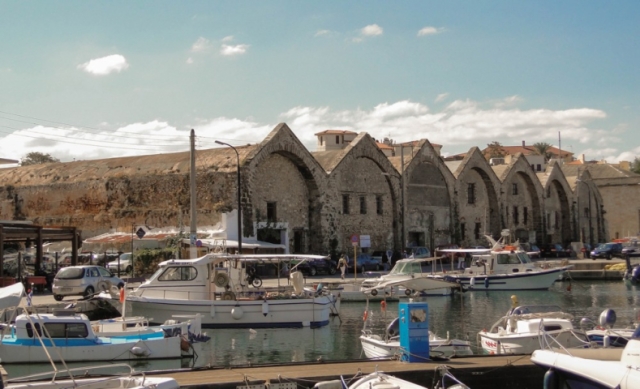
During the Venetian occupation (1204 - 1669), the need for the closer presence of Venetians in Crete made them construct a large number of "Neoria" (arsenal) in Chania, where the ships would be repaired during the winter. The construction of the first two "Neoria" in Chania was completed in 1526. In 1593, sixteen "Neoria" had already been constructed.
In 1599, the south "Neoria" complex was completed with the construction of the 17th "Neorio". In 1607, during the expansion of the northeast rampart, begins the construction of 5 more "Neoria" at the heart of the port to the east. Two of them were completed, however, only the walls to the arch of the third one were constructed. During the Turkish period, the lack of maintenance works in the port and the degradation of the role of “Neoria" also resulted in the alteration of the original function of “Neoria” which were now used as military storage spaces. From the initial "Neoria" complex with 17 "Neoria", nine were demolished.
Nowadays, a group of 7 continuous domes is preserved-along with another one further to the west, the "Grand Arsenal" (today, the Centre of Mediterranean Architecture). Only two "Neoria" are preserved intact from "Moro" complex, at the heart of the port, while in the position of the demolished "Neoria", the stone building of the new customs of Chania was constructed, which is today surrounded by two squares.


 Login with
Facebook
Login with
Facebook