



Your Position:
Unknown
Λεπτομέρειες ΕικόναςImage details
More Photos
 Upload your photos for ΝΗΠΙΑΓΩΓΕΙΟ ΑΞΟΥ and share them with us!
 Press here.


ΝΗΠΙΑΓΩΓΕΙΟ ΑΞΟΥ
 Address:
, Suggest
 Telephone:
, Suggest


Your Opinion

If you want to tell us your opinion about this place, please leave a comment
Post a Comment:

ΝΗΠΙΑΓΩΓΕΙΟ ΑΞΟΥ
ΝΗΠΙΑΓΩΓΕΙΟ ΑΞΟΥ
Places near ΝΗΠΙΑΓΩΓΕΙΟ ΑΞΟΥ

Zoniana village is a mountainous village of Milopotamos province belonging to Rethimnon Prefecture in Crete. It is built on the northern foot of Psiloritis mountain (Mount Ida) in an altitude of about 640 metres. It has a population of about 1,500 inhabitants, the majority of whom are occupied with agriculture and cattle-breeding. The legends and traditions which accompany it are lost in the depths of time. Through these pages one can find out how the village was named, how one can visit it, learn about its history, look at several of its pictures and some other interesting sights, and finally read some myths and legends related to it.The history of the village is lost in the depths of time since according to the legend its formation and name are closely related to Zeus. It also coincides with the history of Axos since the province of the village was part of its realm as well as the area of Anogeia.In 1577 Barozzi cites it as a separate settlement with the name So. Since then the separate history of the village begins for which, however, we do not have any written documents until 1821. Nevertheless, both the recent past and the present of Zoniana manifest its farther past. One thing is beyond the shadow of doubt: that it was never inhabited by Saracen, Venetian or Turkish conquerors, that its population has always been purely Greek and that it always took part whenever Greece called for help. In more detail, the inhabitants of Zoniana participated in the Revolution of 1770 in every way they could and also took care of persecuted Sfakians.In 1821 M. Melitakas from “Zou Lakko (Zoniana) Mylopotamou (it is written in one paint of him at Historical Museum of Heraklio, Crete )”, chieftain of Milopotamos province, fought against the Turks throughout Crete. He got injured in a battle in Brachimio and died because of that wound later. His name is reported at the Book of V. Psilakis “Istoria tis Kritis” page 320. In 1866 twenty inhabitants of Zoniana with Parassirogiorgis decided to leave the safety that the mountains offered them and go to Arcadi, where seventeen of them were killed.Six months later, on May 8 1867, the inhabitants of Zoniana along with those from Milopotamos stroke Omer Pasha Latas in Pera Chalepa. The Turks beat a hasty retreat and the inhabitants of Zoniana took a portable canon as loot, carried it to Zoniana and hid it. Today this canon is in the Maritime Museum of Crete in Chania. On the next day, May 9, the numerous Turkish army wore down the resistance of the inhabitants of Zoniana and entered the village. They interrogated the old and the sick who could not leave the place in order to find the canon. Since no one confessed, they slaughtered everyone and set the village in fire. Along with it the forest of the gorge was also burnt.In November of the same year Kumandar Redic Pasha tried to build a Tower in Kafkaloudi (Amigdalokefalo) like in all the other villages. He did not succeed to do so because the inhabitants of Zoniana did not leave him at ease. Day and night they attacked him and then left (klephtopolemos) and they decimated his soldiers and builders. In turn, he burnt everything that the inhabitants of Zoniana had managed to rebuild and departed. This clearly demonstrates that the village of Zoniana was set on fire twice within six months (both in May and November). According to a song of that period the village had been burnt yet another time: “That’s the third time that the village is burnt but even if it is burnt three hundred times we will not obey the Aghas.”The years went by but the inhabitants of Zoniana did not cease to fight the Turks. They went to Gazi and Servili and along with the inhabitants of Milopotamos and Malevizio they trapped the Turks in Heraclion. There is still today in Gazi a location called “Michanes” which took its name from the conduits that the inhabitants of Zoniana dug and then blew up as the Turks were getting closer. During a battle in which the rebels beat a hasty retreat, they left the flag behind. The inhabitant of Zoniana Michalis Kavvalos or Kaprakis got back and in a cloud of bullets he took it and left. For that reason he was awarded a prize by the Cretan community as the saver of the flag. That is the place where Michalis Nikiforos was killed.During the Balkan Wars thirteen inhabitants of Zoniana sacrificed their lives. During World War II (Northern Epirus – the Battle of Crete – the Greek Occupation) nineteen inhabitants of Zoniana were sacrificed in the name of Greece.Last but not least, during the Greek Civil War another four people lost their lives. Maybe those were the only lives lost in vain however they obeyed to the calls of the Greek government.Text: www.zoniana.gr

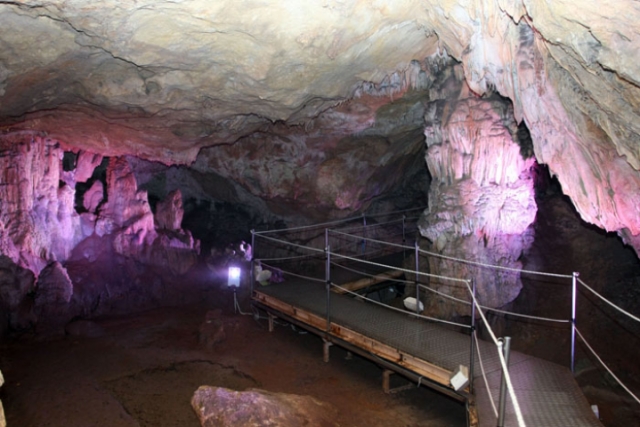


Τhe village of Oaxos, one of the most important cities of ancient Crete, was situated in the area of the modern village of Axos, 44km southeast of Rethymno Town, and flourished from Late Minoan and Geometric up until Roman and consecutive times.
Archaeological pick-axes have brought to light many parts of the ancient city including the temple of Aphrodite, the prytaneum, tombs and a variety of archaeological relics. The wall of the acropolis, remains of which can still be seen today on the summit of the hill, must have been of particular grandeur. In 1899, the Italian Archaeological School started excavations, which uncovered a variety of findings such as Minoan potsherds, stone vessels, inscriptions and many figurines of a naked female body, which is believed to portray the goddess of Fertility.
Furthermore, remains of buildings dating back to the Classical Period were found, on top of which new constructions had been built, mainly Byzantine churches. The city flourished during both the Roman and the Byzantine Period.
During the latter it accommodated the seat of the Episcopate and boasted a large number of churches. At the place of Livada, north east of the village, remains of archaic times have been found, a fact, which indicates the dimensions of ancient Axos.


 Login with
Facebook
Login with
Facebook