



 Upload your photos for ΣΧΟΛΕΙΟ ΔΕΥΤΕΡΗΣ ΕΥΚΑΙΡΙΑΣ ΧΑΝΙΩΝ and share them with us!
 Press here.


Prefecture: Chania
 Address:
 Telephone:




ΣΧΟΛΕΙΟ ΔΕΥΤΕΡΗΣ ΕΥΚΑΙΡΙΑΣ ΧΑΝΙΩΝ
ΣΧΟΛΕΙΟ ΔΕΥΤΕΡΗΣ ΕΥΚΑΙΡΙΑΣ ΧΑΝΙΩΝ
Places near ΣΧΟΛΕΙΟ ΔΕΥΤΕΡΗΣ ΕΥΚΑΙΡΙΑΣ ΧΑΝΙΩΝ


The fortress Revellino del Porto on the northwest side of the port of Chania was constructed by Venetians to prevent any enemy danger for the port. Its construction began in 1610 and completed a few years before the fall of the city in Turks in 1645.
The interior was organized to barracks and ammunition storage areas. It was also the headquarters of the Army Commander of the city. In about the middle of the courtyard, there is a large domed water tank that gathered rain water from the roofs. On the northern side of the wall there are six arched openings that included cannons for the protection of the entrance of the harbour.
During the Turkish period Revellino was used as barrack (Firka = barrack), for that reason the name Firka is still used today. The arched openings were used as prisons from the Turkish period to the civil war. On the corner watch tower of the Fortress the Greek flag of the Unification of Crete was raised on December 1st 1913 in an official ceremony. Today, at the entrance of the Fortress is situated the Maritime Museum of Crete.

The Nautical Museum of Crete is located at the entrance of the historical fortress "Firka". It was founded in 1973 in order to promote the nautical traditions and history of the island. The Museum cooperates and interacts with other Nautical Museums in Greece and abroad.
The permanent exhibition includes 2.500 items, such as relics, objects found in the bottom of the sea, paintings, maps, photographs, models of ships, nautical equipment etc. The exhibits are organized in units, in chronological order from the Copper Age until today. There is also a special exhibition of sea environment, with a rich collection of shells from different places of the world.
An important development step for the Nautical Museum is the creation of a permanent exhibition of ancient and traditional shipbuilding. The main exhibit of the museum is the reconstructed Minoan ship “Minoa” an experimantal model, faithful copy of the original ancient commercial ship. Other exhibits are the tools and the materials that were used for its manufacture, some photographs and a map of its experimental travel.

The rampart Sabbionara still preserves its Turkish name "koum - kapi (Kum Kapisi = the Gate of the Sand), is located on the northeast corner of the Venetian walls and is completely constructed in the sea. On the front of the rampart, the circular Venetian emblem of the lion of Agios Marcos is still preserved. It is the only preserved gate today and its external side had been modified during the Turkish period.
It is the only preserved gate today and its external side had been modified during the Turkish period. The port of Chania cannot be used by modern ships because of the shallow water, which contributed in preserving its old character, maintaining the signs of its conquerors till today.

It is located in the internal part of north-westernside of the fortification walls that was renamed to Monastery of Saint Salvatore. The exhibition is focused on the historical and artistic identity of region of Chania during the Byzantine and Post-Byzantine period.
The exhibits have been separated in units according to their category (Mosaics, Signs, murals, ceramic, sculptures, coins etc.) and are placed in chronological order, accompanied by information tables and maps.
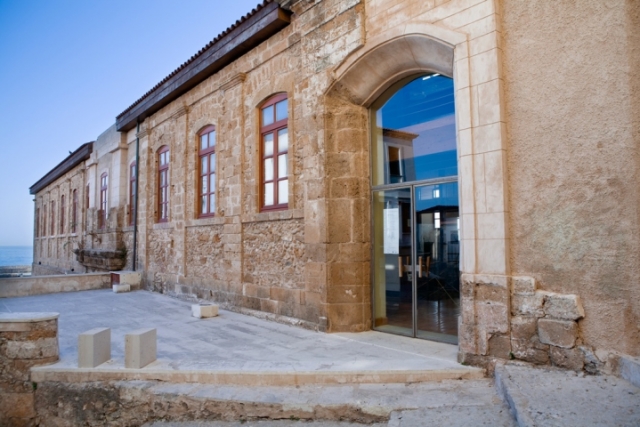

The Grand Arsenal is the last of the 17 Neoria to the west. Its construction started in 1585 by the Intendant Alvise Grimani. A new era began for the Grand Arsenal with the addition of the second flour in 1872 during the Turkish period. The building hosted several important public services and authorities.
Nowadays, it has been transformed from a roofless ruin into an impressive building that hosts various events and exhibitions. Since 2002, after its reformation, it hosts the Center of Mediterranean Architecture, organizing important cultural events, artistic exhibitions and international events related to architecture.
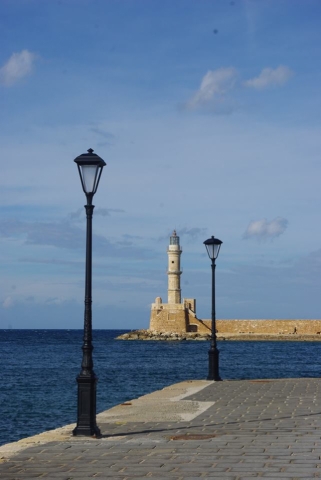

The Egyptian Lighthouse, which is one of the oldest in the world, prevails in the old Port of Chania. The sea-tossed stone lighthouse that is located at the edge of the breakwater, is not only the “guard” of the old Venetian port, but also its most famous jewel.
The lighthouse was constructed by the Venetians at the end of 16th century. It has been reconstructed by the Egyptians during the period 1830-40, when English had assigned Crete to the regent of Egypt, Mehmet Ali. At the end of the Ottoman empire, the project had been completed with the addition of the ladder in its east side, as well as pipes, through which passes sea water under the surface of its base. The lighthouse has a hight of 21m, height from sea surface 26m and its light reaches a distance of 7 miles. Its base is oktagonal, the middle part has 16 angles, while the top part is circular.
Bulwark San Salvatore
This is located on the North-west corner of the Venician fortifications and it was named after the Monastery of San Salvatore, still surviving in the area. Over this bulwark, there is a four-sided watch-tower which, together with the Fort of Fircas, could protect the sea and a part of the west side of the fortifications.


During the Venetian and Turkish period, Chania presented a high development in commerce and marine mercantile. Not only in imports but also the export of various products was notable, despite the lack of a large and safe port. Since this time, it was common knowledge that the port of Chania was vulnerable due to the weather conditions and for this reason it was not considered an appropriate port. The natural port of Souda, on the other hand, was in a much better position and was perfect for a port. After the occupation of the city by the Genoans, the need for the construction of a port was once again highlighted, and the local authorities started the construction works during the Venetian period. In 1302, the request was submitted to the government by the Rector Marino Gradenigo and was finally accepted.The first phase of the construction of the port was between 1320 and 1356. However, during this time it was once again realized that the natural condition and morphology of the port was inappropriate, as the port was overall small in size and shallow, it was vulnerable to north and west winds, and its east basin suffered from alluvions. Thus, the reports of the officials often record the urgent need to clean and deepen the port (especially its east basin).After the revolution of "Aghios Titos" (1363-64), the port of Chania is abandoned and the port of Heraklion is used instead, as the port of Rethymnon presented similar problems. During the Venetian period, in 1551, a second request was submitted to deepen the port of Chania and to construct a wall with battlements to protect the ships from the rocks and reefs.In 1645 however, the city falls into the hands of the Turkish army after siege. The occupation of Crete by the Turks was official in 1669, after 25 years of war, when "Handakas" (Heraklion) fell. The new rulers of Crete had no interest to maintain the port of Chania, which was completely neglected during the Turkish period.Between the years1831-1841, Crete was assigned to the Regent of Egypt, Mehmet Ali, as a gift for his services to the Sultan during the 1821 revolution in Crete and Peloponnese. The value of the port of Chania was then recognized, as well as its potential to improve the local economy. It is said that Mehmet Ali ordered Mustapha Pasha to clean the basin of the port of Chania, to conduct maintenance works and to construct the lighthouse. Indeed, the construction works were finally completed, after a lot of effort and money.However, even then the ships were not able to approach the land, especially when the weather conditions were harsh, and the passengers and goods were transferred by small boats from the ships to the land, in front of the Mosque of "Kioutsouk Hassan", commonly known as "Giali Tzamisi". Nowadays, the picturesque Venetian port of Chania gathers a large number of visitors and local people, especially during the summer months. There are many restaurants, taverns, bars and cafeterias lengthwise to the coastline to offer you a pleasant time and entertainment.


Maritime Museum of Crete
Exhibition of Ancient and Traditional Naval Architecture
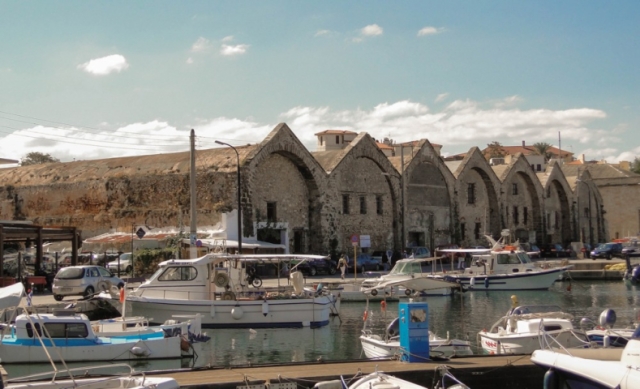
During the Venetian occupation (1204 - 1669), the need for the closer presence of Venetians in Crete made them construct a large number of "Neoria" (arsenal) in Chania, where the ships would be repaired during the winter. The construction of the first two "Neoria" in Chania was completed in 1526. In 1593, sixteen "Neoria" had already been constructed.
In 1599, the south "Neoria" complex was completed with the construction of the 17th "Neorio". In 1607, during the expansion of the northeast rampart, begins the construction of 5 more "Neoria" at the heart of the port to the east. Two of them were completed, however, only the walls to the arch of the third one were constructed. During the Turkish period, the lack of maintenance works in the port and the degradation of the role of “Neoria" also resulted in the alteration of the original function of “Neoria” which were now used as military storage spaces. From the initial "Neoria" complex with 17 "Neoria", nine were demolished.
Nowadays, a group of 7 continuous domes is preserved-along with another one further to the west, the "Grand Arsenal" (today, the Centre of Mediterranean Architecture). Only two "Neoria" are preserved intact from "Moro" complex, at the heart of the port, while in the position of the demolished "Neoria", the stone building of the new customs of Chania was constructed, which is today surrounded by two squares.


 Login with
Facebook
Login with
Facebook