





 Upload your photos for Kato Peristeras Cave and share them with us!
 Press here.


Prefecture: Lassithi
 Address:
Sitia
Address:
Sitia  Telephone:




Kato Peristeras Cave
Located approximately 1.3 km east of the village of Karidi, 22 km from Palekastro and 20 from Sitia. There are two noteworthy caves ίn the Karidi area, both with traces of inhabitation. They are the Katofygi cave at Limnilakkos and the Peristeras cave. This latter is one of the more important Cretan caves. It is some 300 m north of the public road, and the place is known both as Platyvolo and Peristeras. The mouth of the cave is 540 m above sea level. It is a deep subterranean cavern opening into Jurassic lίmestone, and there is a difference of 63 m between the level of the entrance and the lowest point.The opening is 23,5 m wide and 12 m high, but a big rock fall prevents close examination of much of the entrance area. From here one passes into a huge chamber 80 m deep and 35 m wide; at one part the height varies between 2-12m. At the left of the back of this chamber a narrow gap leads, after a sharp drop of 4m, into a series of curved chambers which swing round to connect υp again with the left wall of the main chamber. Nature has adorned the first two chambers richly with stalagtites, stalagmites and pillars of stone. In the third and fourth chambers human bones were found, and other signs of habitation. From eχamination of the sherds it has been concluded that the cave was in use from the Εarly Μinoan to the Late Μinoan period, and also in Byzantine times.From the book "Sitia", N.Papadakis, Archaeologist,1983
Places near Kato Peristeras Cave

Magas (Brysidi)
A small village whose inhabitants gradually abandoned it around 1850 and went down to Palaikastro seeking more fertile fields. A few traditional stone houses have been preserved, as luckily some descendants return and renovate them with care and respect, to blend in with the rocky landscape.
Mitato (the word means «cheese dairy» in the Cretan dialect) is the central village of a community of five small villages, the other four being Chonos, Xerolimni, Krioneri or Misiryou (perhaps derived from the Latin missir: gentleman or lord, or Misr: Egypt) and Vrisidio or Magassa. The road to these villages passes through Roussa Ekklisia. Prehistoric tombs were found at Langos in the Mitato district, and on the summit of the hill Modi (539m) which also belongs to the community. Mitato Mitato Mitato An open-air peak sanctuary was excavated in 1971. This had not been plundered and many votive offerings were found, including a lot of bronze votive knives. Traces of a building were also located. Nowadays, because of the high mountain climate (590m above see level), fewer and fewer people live permanently in these villages; most of the former inhabitants spend the greater part of the year in Palekastro or Sitia


The Epano Zakros spring has been formed due to the contact between two water permeable Tripolitsa limestone formations, which are thrust on the non permeable metamorphic rocks of the Phyllite-Quartzite unit. The water moves through the caves of Zakro’s mountains until it reaches its exit at the spring. The water from the spring irrigates the entire surrounding region, while it preserved important ecosystems that even reach Kato Zakros. In the past, it supported several watermills, some of which are preserved to this day.
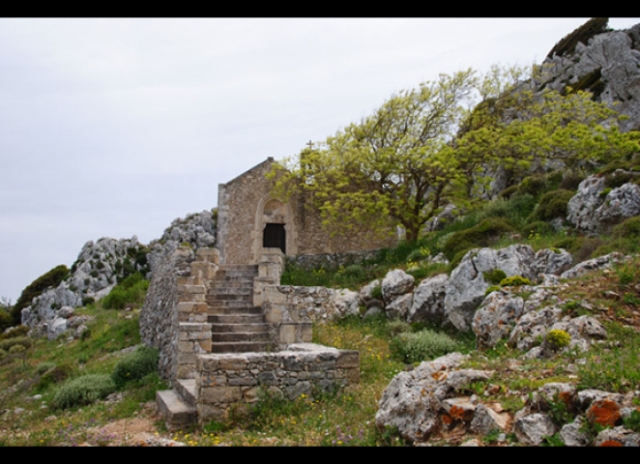
This village, about 25 km from Sitia, 23 km from Palekastro and 600m above see level, is reached either by a road that passes through various mountain hamlets (Metochia Piskokefalou) or by a new road that branches off the road from Palekastro to Zakros near Adravasti; it is approximately 8 km from the main road. A stone slab with a sculpted relief of a branch of walnut tree complete with nuts, is said to have been found at a local place called Koutsounara, and the name of the village is derived supposedly from this find (Karidia: walnut tree).In the Venetian census of 1583 it is not mentioned. although it is marked on contemporary maps and mentioned in deeds of the period.In proper excavations have yet been carried out, but of the chance finds from the district the most important is a very fine stone double axe which is now ίπ the Iraklion Museum.
Karidi Karidi Karidi There are two noteworthy caves in the Karidion area, both with traces of inhabitation. They are the Katofigi cave at Limnilakkos and the Peristeras cave. This latter is one of the more important Cretan caves. It is 1 km east of the village, some 300 m north of the public road, and the place is known both as Plativolo and Peristeras.The mouth of the cave is 540 m above sea level. It is a deep subterranean cavern opening into Jurassic Limestone, and there is a difference of 63 m between the level of the entrance and the lowest point.
Karidi
The opening is 23,5 m wide and 12 m high, but a big rock fall prevents close examination of much of the entrance area. From here one passes into a huge chamber 80 m deep and 35 m wide; at part the height varies between 2-12m. At the left of the back of this chamber a narrow gap leads, after a sharp drop of 4m, into a series of curved chambers which swing round to connect up again with the left wall of the main chamber.Nature has adorned the first two chambers richly with stalagtites, stalagmites and pillars of stone. In the third and fourth chambers human bones were found, and other signs of habitation. From examination of the sherds it has been concluded that the cave was in use from the early minoan to the Late minoan period, and also in Byzantine times.
From the book "Sitia", N.Papadakis, Arcaeologist,1983

A small plateau and its village between Handras (or Ziros) plateau to west and Karidi village to north, at 620 m above sea level, 18 kms from Sitia, whose name probably has some connection with ancient Itanos.
One of the largest caves in Crete, Oxo Latsidi, can be found to the northwest of the village at Patelia. In south-west of the village a Minoan farmhouse was found. At the location Vrissi, on the edge of the village, a wonderful fountain of Ottoman architecture was restored recently.
The whole plateau (with Ziros Plateau) is planted with vineyards and the region is famous for its wine and raki production.

It includes natural sculptures chiseled by the weather and erosion in the Tripolitsa limestone rock formations, and which can be found on the footpath leading from Epano Zakros to Skalia. These processes create strange rock forms that look like statues, and with a little imagination one can make out familiar silhouettes from the animal kingdom!
http://www.sitia-geopark.gr/

The second gorge of Epano Zakros is located to the north of the first one and is also an impressive geotope. The gorge can be seen from the country road going from Karydi to Adravasti.
The first gorge of Epano Zakros starts from the dirt road exactly above the spring of Epano Zakros. The gorge is very impressive, especially after the dirt road where unique landforms have developed in its walls.
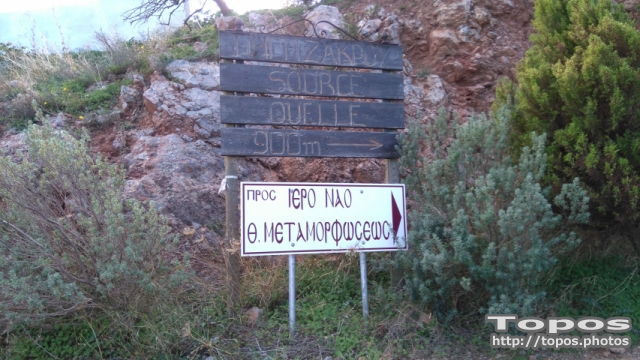

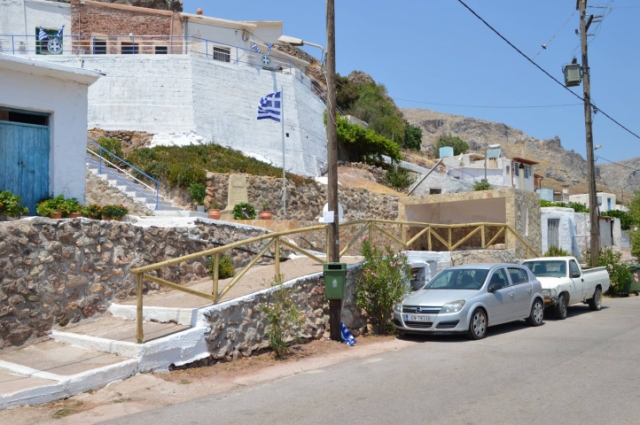
This village belongs to the Itanos Municipality. The origin of the name is unknown, perhaps it is derived from a family name. It is not mentioned in the 1583 census, but it is believed to have been razed with other villages during Turkish pirate raids in 1471 AD and later reestablished after the 16th century.
Το the west of the settlement is the hill of Endichtis (560m) which was believed to have been the site of a peak sanctuary. Excavations in 1972 however proved that this could not have been so. Various things such as loom weights, a whetstone and clay spindle whorls were collected, but not one single figurine, which seems to exclude the possibility of this spot having been a shrine. So it must be regarded rather as a simple habitation.
Adravasti is 36 km from Sitia, 2 km from Zakros and 16 from Palekastro.From the book "Sitia", N. Papadakis, Archaeologist, 1983
Between the hamlets of Magassa and Mitato and in certain segments of the country road that connects them, portions of the old cobbled road that used to connect the two hamlets is still preserved.


The plateau of Mavros Kambos can be found between Epano Zakros and the area of Skalia, crossing the E4 European long distance path. It is a beautiful plateau which is home to several small wetlands.

Maza gorge starts in Karydi and ends just outside Adravasti. It is long with impressive landforms in its interior, however the trail is only for experienced canyoners. In the past it was the main road connecting various hamlets.
Karydi Info Center
The Info Center at Karydi is hosted at the old school of the village and is dedicated to the speleological research. The center offers information on the Nature Park, the nearby geo-routes and the activities that can be implemented, but also can be used for accommodation of small groups and scientists.
Center is equipped with the necessary infrastructure and facilities for stay and sleep that can be used by speleologists, biologists, schools etc., that are interested to study the environment and caves of this mountainous area. It also can provide visitors with the necessary equipment for personal security and orientation.
Visitors who wish to use this infrastructure should communicate with Parks authorities or the Municipality of Sitia.
Mitato (the word means «cheese dairy» in the Cretan dialect) is the central village of a community of five small villages, the other four being Chonos, Xerolimni, Krioneri or Misiryou (perhaps derived from the Latin missir: gentleman or lord, or Misr: Egypt) and Vrisidio or Magassa. The road to these villages passes through Roussa Ekklisia. Prehistoric tombs were found at Langos in the Mitato district, and on the summit of the hill Modi (539m) which also belongs to the community. Mitato Mitato Mitato An open-air peak sanctuary was excavated in 1971. This had not been plundered and many votive offerings were found, including a lot of bronze votive knives. Traces of a building were also located. Nowadays, because of the high mountain climate (590m above see level), fewer and fewer people live permanently in these villages; most of the former inhabitants spend the greater part of the year in Palekastro or Sitia Mitato Mitato From the book "Sitia", N.Papadakis, Arcaeologist,1983


 Login with
Facebook
Login with
Facebook