




 Upload your photos for Venetian Walls and share them with us!
 Press here.


Prefecture: Heraclion
 Address:
 Telephone:




Venetian Walls
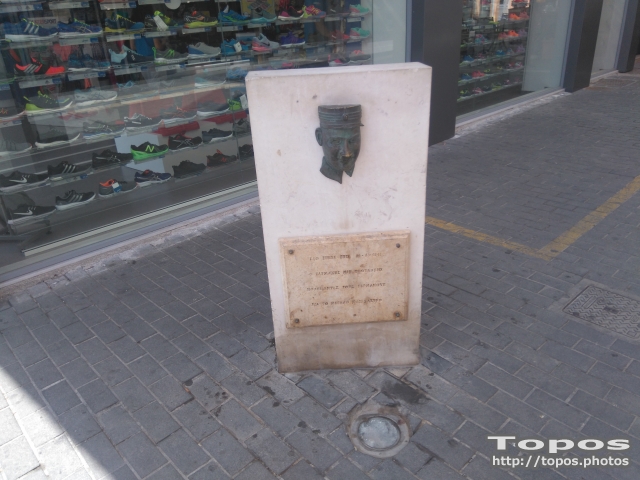
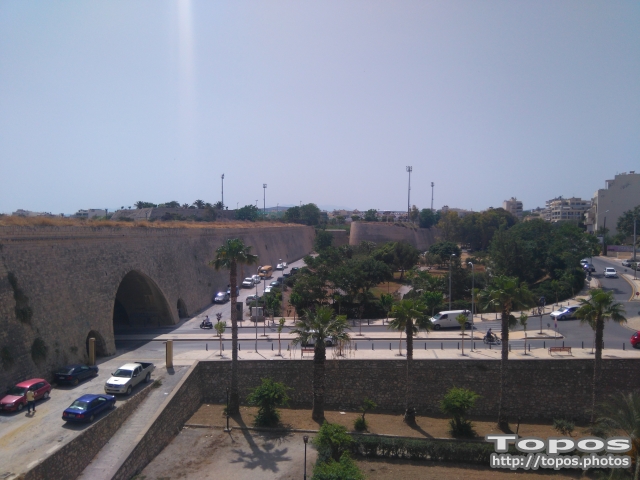
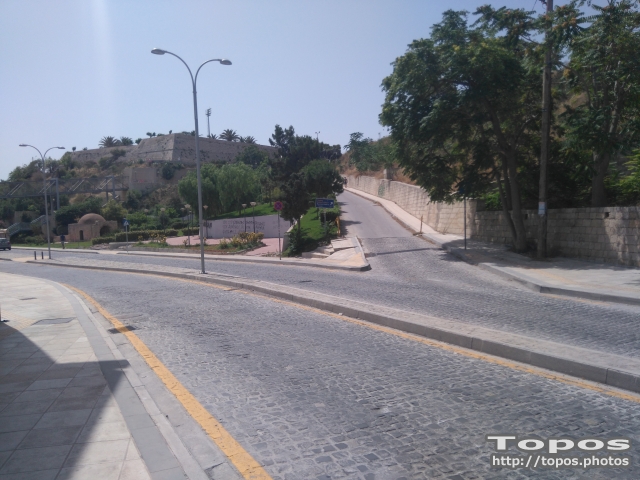
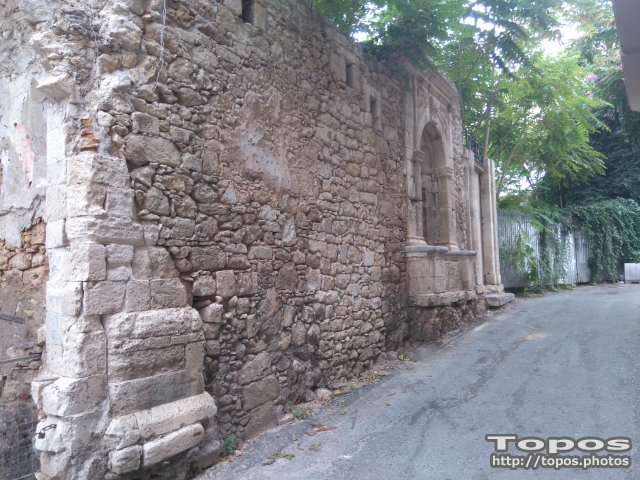
Admired as one of the most inspired and best-designed examples of fortification in the entire Mediterranean basin, the 16th and 17th century enceinte surrounding Venetian Candia has survived the ravages of time. Triangular in shape, with its base at the sea, the mighty enceinte has a perimeter of about 5.5 kilometres. The hallmark of the defensive layout are the bastions, linked by curtain walls decorated at many points by escutcheons and the lion of St. Mark, symbol of Venetian omnipotence. The gates in the enceinte, which served to link the town to the countryside, still stand as important architectural monuments.
To this day, the walls that withstood the Ottoman siege in the mid-17th century mark out the boundary of the old town.
Historical phases
The strategic position at which Chandax lay in the Mediterranean made it a frequent target of raids by those wishing to gain control of the wider area.The fortifications around the Arab "Fortress of the Ditch", Byzantine Kastro and Venetian Candia reflect both the identity of the conquering powers and developments in warfare and fortification technology. At each stage the defences had to cater for the demands of what was a rapidly expanding city.
Bastions
The bastion was the main feature of the new defensive design known as the bastion system or Fronte Bastionato. This was first implemented in the 16thcentury and completed in the 17th, to afford better protection from new firearms created after the invention of gunpowder. Bastions are large, solid constructions projecting from the main line of defence, designed to protect adjacent bastions, the curtain wall and the ditch.
Curtain walls
The bastions were linked by straight sections of wall known as curtains, made of thick earthworks inclined on the exterior to form the scarp, and revetted or faced with ashlar blocks. Sturdy foundations projecting beneath the base were required to support the massive superstructure.
Piazze basse
One of the distinctive features of the bastion was the piazza bassa (lit. "low square"), constructed in the bastion flank, at the point where the bastion abutted the curtain wall. Every landward bastion had two such piazze, built at an intermediate level between the ditch and the scarp. They were protected by the rounded sections at the ends of the bastion faces, which became known as oreillons on account of their resemblance to ear lobes.
Cavaliers
In order to improve surveillance of the area beyond the ditch (the glacis), the Venetians planned and constructed additional small-scale fortifications known as cavaliers. These were initially built on the curtain walls and later on or near the bastions.
Ditch
The ditch surrounding earthworks was designed to keep the enemy as far from the enceinte as possible, and thus formed an essential, integral part of any fortifications. Before the bastion system was employed, the ditch was filled with water to form a moat aimed at further inhibiting any attempt to get near the main fortifications, though that around Chandax was always dry.
Outworks
In order to fortify the weakest positions in the enceinte and keep the enemy even further from the ditch and the walls, the Venetians built twelve additional outworks to serve as heavy artillery emplacements.
Defenders reached the outworks by means of underground passages that ran from the ditch.
The only such defence still extant is the Fortress of St. Dimitrios, to the east of the enceinte opposite the Vitturi Bastion. All the other outworks have been demolished, though their trace survives in the outline of modern building blocks.
Escutcheons
The Venetian enceinte is studded with escutcheons, most of which are to be found above the gates, on bastion oreillons, curtain walls and on the Koules fortress. Often accompanied by dates or inscriptions, these emblems and coats of arms bear witness both to the presence of Venetian nobles and officials and to their involvement in various phases in the building of the fortifications. Yet what best illustrates Venetian dominion over the city is the winged Lion of St. Mark, symbol of the Serenissimi. Depicted in relief, this is encountered in a range of different versions.
Magazines
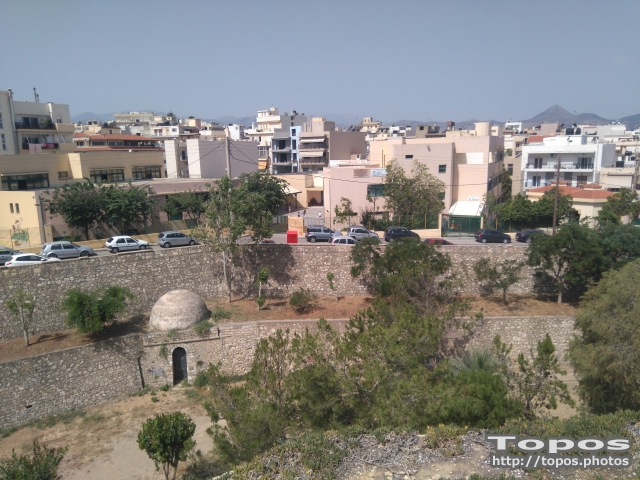
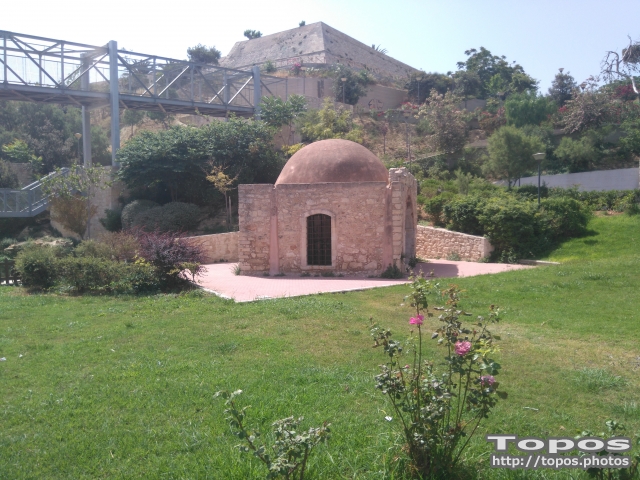
Magazines for the storage of gunpowder barrels were erected throughout the city. Built of stone, they were either round and domed or square with a pyramidal roof. Most of them were located near bastions, since they were directly related to military readiness and warfare.
Gates
A number of entrances built into the town enceinte enabled communication between fortified Candia and the outside world. Depending on their use, these were classified as city gates, i.e. those which served the movement of goods and people in addition to defence, and strictly military ones for the exclusive use of the town guard, such as the Bethlehem Gate. Regardless of their use, almost all of these gates were situated near bastions or other strong points in the fortifications, so as to be adequately protected in case of enemy assault.
Equipped with a special guard and large wooden doors that opened at dawn and closed at dusk, gates in the first category (the St. George, Jesus and Pantocrator Gates) linked the town to the outlying country. A significant role was also played by the so-called shore gates, which secured communication between the town and the port and sea: the Harbour Gate, the Arsenal Gate, the Dermatas Gate, the Sampionara Gate and the St. Andrew Gate (the last of which were adjacent to the bastions of the same name).
Most of these entrances remained in use in the Ottoman period, up until the early 20th entry. The arrival of the first cars on the island then rendered the old Venetian gates inadequate; new entrances capable of catering for modern transport needs were then created, usually at a short distance from them.
Places near Venetian Walls


The Gate Makasi (meaning "switchman" in Turkish) is a military gate of the Venetian Walls of Heraklion, the gallery of which had a length of 110 meters. The gallery leads to the eastern low square of Martinengo bastion, that housed the canons that protected the bastion Bethlehem.
The gallery is used as a memorial for the National Resistance in Crete, as here the Germans imprisoned hundreds of locals in the Second World War. On July 15, 1943, when the so-called Big Blockade of Crete took place, dozens of Christians and Jews were captured and imprisoned here.
On November 4, 1943, many prisoners were transferred to Mauthausen concentration camp, while other 600 boarded on June 8, 1944 in Tanais ferry to Piraeus. However in the open sea, the Germans got rid of the 600 souls by sinking the ship and then announced that the British navy sank ship. The Germans never paid for these atrocities, just like all such stories in Crete.


Heraklion
Capital of Crete
Heraklion or Iraklion (Greek: ÇñÜêëåéï; Italian: Candia), is the largest city and capital of Crete. It is also the fourth largest city in Greece. Its name is also spelled Herakleion (transliteration of ancient/Katharevousa name), or Iraklio, with other variants. For centuries it was known as Candia (Greek: ×Üíäáî or ×Üíäáêáò, Turkish: Kandiye).
Heraklion is the capital of Heraklion Prefecture, with an international airport named after the writer Nikos Kazantzakis. The ruins of Knossos, which were excavated and restored by Arthur Evans, are nearby.
Heraklion shows his visitors its beauty only on the second glance.
Heraklion is the largest urban centre in Crete, the capital of the region and the economic centre of the island. The first European civilisation, the Minoan civilisation, flourished on this land 5000 years ago. The conquering of Constantinopole by the Franks in 1204, left Crete under the sovereignty of the Venetians until 1669. During this period, Heraklion experienced significant cultural growth and became the capital of the ''Regno di Candia''. However, all this cultural and spiritual growth came to a sudden end in 1669 with the invasion of Crete by the Turks. Crete became autonomous in 1897, to be united with Greece in 1913. The cultural heritage of the city of Heraklion offers a variety of forms of modern entertainment. Every year, the city, as well as numerous villages in the surrounding area, organize cultural events such as theatrical performances, art exhibitions, musical nights and festivals which attract a lot of people, locals and visitors alike. For those inclined to modern entertainment and clubbing, the city offers ample opportunities for night life. Heraklion is a city with one foot rooted in the past, the other stepping into the future. Currently the population of Heraklion is approximately 150000 people. It is a very dynamic and cosmopolitan town, particularly during the summer period when thousands of visitors can be seen shopping in the market or visiting the museums and other places of interest. Today Heraklion is the top choice for tourist destinations in the Mediterranean.
The unique natural beauty favours the development of alternative forms of tourism and provides a combination of mountain and sea sports.
The city is also the commercial and scientific centre of the island. It has a strategic geopolitical position in the southeast basin of the Mediterranean Sea connecting three continents and many different cultures.
During the last 20 years the city has made remarkable progress in the academic and technological fields.
The dynamic and imaginative combination of natural beauty, climate, strategic position, cultural heritage and scientific background has created an appropriate environment to add value to the broader entrepreneurial activity in the region and stimulate the local economy.
The city of Heraklion still enjoys its reputation as one of the most attractive Mediterranean capitals. It has enough to offer that the cultural tastes and shopping needs of both the visitors and the residents are fully catered for. It is no accident that it has always been the business and social center of Crete throughout the ages and that status is maintained today. It plays host to many interests and activities as well as providing a very pleasant way of life.
What to see in the city
For those who wish to learn a little bit about the history, Heraklion is home to ancient monuments and examples of major Western civilization. The region of Heraklion is famous for Zeus, the Greek god of hospitality, who met and fell in love with a Princess of unsurpassed beauty, named Europa. She gave birth to the race of Minoan Kings and sages, the founders of the earliest civilized nation in Europe.
There are many medieval monuments that indicate the prosperity of the era, situated in the center of the city. If you continue onwards from the port to the city centre, the first significant landmark you can see is 'Lotzia'. Nowadays this houses the City Council and part of the Municipality of Heraklion services departments. 'Lotzia' used to be the society for the Duke and Officers of Crete, and is decorated with uniquely sculptured coats of arms, trophies, and metopes. For centuries the noblemen of Crete gathered here to rest, to be entertained, or to practice their formal rituals. Its passageways (stoas) have their roots in the 14th century, but 'Lotzia' took its final architecture from the early part of the 17th century. It is located in the PIAZZA DEI SIGNORI (Square of the Administrative Authorities). It is considered to be the finest Venetian monument in the city, and was awarded the EUROPA NOSTRA first prize in 1987, for best renovated and preserved European monument of the year.
The majestic fortress, 'Koules', stands by the port. It had been used for centuries not only for the protection of the city but as a prison too, with its huge dark hallways and cells.
In the southern part of the city the palace of Knossos is situated, which was built in preclassical times, when Crete was still under reign and consisted of a hundred cities. In the center of Heraklion, at the North-east corner of 'Liberty Square' (Platia Eleftherias) is the Archeological Museum of Crete. Every year thousands of visitors come to admire fabulous treasures from the Minoan, historic, classical, Hellenistic and Roman times.
West of Heraklion, there is the Cretan History Museum, where the riches of the Christian, Byzantine, Medieval and earlier times are preserved for all to see. There are also many objets d'art, examples of Cretan popular culture through the ages. These include pieces of work by the great painter El Greco, who was born and studied painting in Heraklion itself. In the same Museum we can also find hagiographies from the famous Cretan School of Hagiography. In addition, visitors have the chance to see a typical Cretan house as well as memorabilia of the great author, Nikos Kazantzakis.
Just a few meters from the Church there is an elaborate fountain, called 'Liontaria' (lions). It is exquisitely sculpted and decorated with images inspired by the sea and the animal kingdom. It was constructed during the first decades of the 17th century by Franzisco Morozini, not only to decorate the square but also to provide the city with water.
South of the 'Lotzia' is the Basilica of Saint Marcus which was built in 1239 in the Piazza delle biade (Square of Blades) and used to be the Cathedral of Crete. The Basilica belonged to the reigning Duke and it was used as the Dukes' burial place. Nowadays it houses the Municipal Art Gallery.
Heraklion is surrounded by an enormous medieval wall, which used to protect it from enemies and gave the city its reputation as the best-fortified state in the Mediterranean basin. It stood up to a siege by the Turks for 25 years but the city was finally seized after its betrayal by a Venetian Engineer who led the invaders through a secret passageway into the city.
The Medieval monastery of Saint Catherine stands in the southwest corner of Lion Square. This building used to be the Cretan University during the Middle ages, through which many European artists, philosophers, church fathers, poets and authors rose to prominence. Nowadays the church of Saint Catherine houses a priceless collection of Cretan hagiographies.
A few meters from the church, you will find the Cathedral of Saint Minas, who is the patron saint of the city. Saint Minas rescued the Christians from slaughter when the Turks had tried to annihilate them in the early 19th century. The church took thirty years to construct and was inaugurated in 1896 with lavish celebrations. Next to it we can find the older, smaller church of Saint Minas, embellished with magnificent hagiographies and icons created by great hagiographers.
Stroll around the city center
The central market and the shops in Heraklion are among the most diverse in Crete. Visitors can easily find souvenirs, jewellery, furs, food, and clothes for any price. Famous Cretan products such as oil, wine, raki(spirit), honey and herbs are really worth tasting and buying. The 'Martinengo' battlements rise from the south part of the wall, where the celebrated Nikos Kazantzakis, author of Zorbas and the Odyssey, was buried. South of here is the Old Gate called 'Hanioporta'. Lots of old churches and battlements still decorate Heraklion, which in addition to having a rich cultural heritage is very lively during the day and night.
Festivals
Every evening during the summer, the Municipality of Heraklion organizes several arts events in its charming open-air theatres. The Festival has been honored by the presence of the Bolsoi Ballet, Kirof, the Opera di Vienna, Joan Baez, Theodorakis, Hatzidakis, Markopoulos, Brubek, Moustaki, Roussos, Halloway and Alvinand Berzam. The Festival begins in June and finishes in September, but during the rest of the year, art exhibitions, shows, recitals and concerts take place. At Christmas, Easter and in May there are celebrations for Holy Days and also for the Battle of Crete in 1941.
Life today
Arts events still take place, which are examples of a both a flourishing civilization and a creative development.
Night life
In Heraklion there are many nightclubs as well as tavernas/restaurants with Cretan and other folk music with dancing.
Hotels
In Heraklion there are a great number of hotels ranging from one to five star, various rooms to rent and many travel agents and car rental firms. See hotels...
Food
There is a great number of restaurants and tavernas, which offer traditional Cretan food as well as international cuisine. Local 'raki', 'ouzo'(spirits and fish-taverns are well known for their local delicacies, traditional drinks and low prices.
Airport
The Heraklion airport is named after Nikos Kazantzakis and is very busy, being the link between Crete and everywhere else in Greece and Europe. In addition, Heraklion port is the link to Piraeus, Thessaloniki and the Aegean islands.




Study and Management of the Natural Environment of Crete Public awareness, education and sensitisation of local people as well as the visitors of the area Link University activities with Cretan society Set up a network of Ecological Museums in Greece and throughout the Eastern Mediterranean
Eastern Mediterranean is unique at a global level due to the great ecological and cultural complexity. The evenness as well as the contrast, the stability, many affinities and the special features characterizes the area.The aim of the Natural History Museum of Crete is the study, protection and promotion of the special features of the area of Eastern Mediterranean.The foundation and the development of NHMC were favoured by the following conditions:
The potential of the University of Crete and its ability to promote modern technologies in the field of environment The geographical position of Crete, lying it the center of Eastern Mediterranean and the southernmost part of the European Union The warm acceptance and support of the local society
Structure and OrganizationOn the basis of the presidential law for its establishment and the university rules, NHMC:
Runs in the context of the Faculty of Science of the University of Crete Consists of five departments: zoological, botanical, anthropological, and geological - mineralogical
The laboratories and collections of the Museum are located at the premises of the University of Crete.11th International congress on the Zoogeography, Ecology and Evolution of the Eastern Mediterranean(21- 25 September 2009, Irakleio, Crete, Greece)For the exhibition halls:Opening Times and AdmissionMonday to Friday: 09:00 to 16:00Weekend: 10:00 to 17:00Natural History Museum of CreteUniversity of CreteSofokli Venizelou Avenue (west of the port of Heraklion)Heraklion, Crete GreeceTel:+30 2810 282740

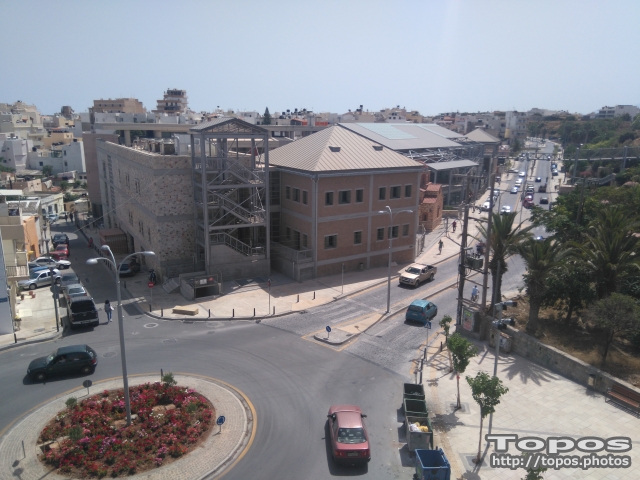










Theotokopoulos Park is the most central and one of the few green parks in the heart of the Heraklion. It takes its name of the great Cretan painter of the Spanish Renaissance, El Greco, and his marble bust decorates the park.
Previously, during the Venetian occupation, in this place there was the Palazzo del capitano generale, the palace of Venetian Vice-Admiral. Venetian period maps depict it as a large three-storey building with multiple arched openings on the ground floor, boasting a chapel and a large courtyard. Later, the palace was converted into a court of the Turkish authorities, and then housed the first Town Hall of the Cretan State. The building was finally demolished in 1943.
Over the past decade, the park has been redisigned, has been planted and a playground built in it.



 Login with
Facebook
Login with
Facebook