



Your Position:
Unknown
Λεπτομέρειες ΕικόναςImage details
More Photos
 Upload your photos for Agios Ioannis and share them with us!
 Press here.


 Address:
Ασή Γωνιά, Ελλάδα
Address:
Ασή Γωνιά, Ελλάδα  Telephone:




Places near Agios Ioannis


Kallikratis is situated off the beaten tourist path, scattered on a small plateau in Lefka Ori (southwest Crete) with an average altitude of 540m. Kallikratis can be reached via Asi Gonia, via Asfendou or via a newly paved winding road north of Kapsodasos that offers stunning views of the Frangokastello plain and the Libyan Sea in the distance.
Kallikrates has become a well known name in Greece, being the name given to the government scheme to overhaul local Municipalities, but in Crete it is also the name of a small Plateau and mountain village in Sfakia (west Lefka Ori mountains) where just three Sfakian families remain (2011).The village of Kallikratis was the birthplace of the family of Cretan artist Kostas Mountakis. Located at an altitude of 540 meters, the village and was named by Manoussos Kallikrates, who in 1453, with 1500 men and five ships, led a campaign to defend the area from the Ottomans Kallikrates is accessible either through the village of Asfendou from the west, Asi Gonia from the east or from the windy road which starts north of the village of "Kapsodasos" and ends in the plateau of Kallikrates. Southwest of the plateau is Kallikratis Gorge, which leads to the village of Patsianos. The gorge is 4 km in length.
Walking the Kallikratis - Argiroupoli E4 path.Route - Natural environment: The route is the continuation of the E4 northern branch, coming from the administrative region of Chania. After Kallikratis plateau, the path goes down to Asi Gonia, crosses Giparis gorge and ends up at the water springs of Agia Dinami and the village of Argiroupoli.
The prevailing rocks of the region are limestone rocks with firestones, while there are also: A Phyllitic - Quartzose texture (with schist, phyllites, quartzites, meta-basaltic and meta-gabbro rocks) ñ Colluvial deposits containing mainly limestone ñ Breccia and porous dolomites.
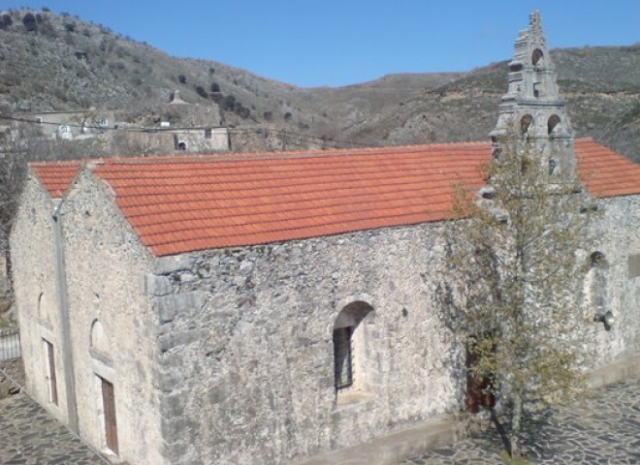
Kallikratis is a stockbreeding village with a great amount of water and vegetation surrounding it. The church of Agios Georgios, the patron saint of flocks, is very interesting.History
Kallikratis has a long tradition of participation in liberation struggles. During the Cretan revolution of 1867, Turkish forces under the command of Omer Pasha tried unsuccessfully to invade Sfakia via Kallikratis. During the German Occupation, Resistance forces had installed a radio in the Anemospilios cave near Kallikrates. The partisan George Psychoundakis in his book, "Cretan runner" states that he had remained hidden in the cave in the spring of 1942, aided by locals. In 1943, the paramilitary group of Fritz Schubert (a branch of the German Wehrmacht) looted and burned the village and executed more than 30 people in retaliation for the participation of local people in resistance against the Nazis. Now that "Kallikratis" is the new benchmark of local government reform, the Sfakian Kallikratis remains a proud corner of Crete.
Kallikrates has become a well known name in Greece, being the name given to the government scheme to overhaul local Municipalities, but in Crete it is also the name of a small Plateau and mountain village in Sfakia (west Lefka Ori mountains) where just three Sfakian families remain (2011).The village of Kallikratis was the birthplace of the family of Cretan artist Kostas Mountakis. Located at an altitude of 540 meters, the village and was named by Manoussos Kallikrates, who in 1453, with 1500 men and five ships, led a campaign to defend the area from the Ottomans Kallikrates is accessible either through the village of Asfendou from the west, Asi Gonia from the east or from the windy road which starts north of the village of "Kapsodasos" and ends in the plateau of Kallikrates. Southwest of the plateau is Kallikratis Gorge, which leads to the village of Patsianos. The gorge is 4 km in length.
Walking the Kallikratis - Argiroupoli E4 path.Route - Natural environment: The route is the continuation of the E4 northern branch, coming from the administrative region of Chania. After Kallikratis plateau, the path goes down to Asi Gonia, crosses Giparis gorge and ends up at the water springs of Agia Dinami and the village of Argiroupoli.
The prevailing rocks of the region are limestone rocks with firestones, while there are also: A Phyllitic - Quartzose texture (with schist, phyllites, quartzites, meta-basaltic and meta-gabbro rocks) ñ Colluvial deposits containing mainly limestone ñ Breccia and porous dolomites.
Kallikratis is a stockbreeding village with a great amount of water and vegetation surrounding it. The church of Agios Georgios, the patron saint of flocks, is very interesting.History
Kallikratis has a long tradition of participation in liberation struggles. During the Cretan revolution of 1867, Turkish forces under the command of Omer Pasha tried unsuccessfully to invade Sfakia via Kallikratis. During the German Occupation, Resistance forces had installed a radio in the Anemospilios cave near Kallikrates. The partisan George Psychoundakis in his book, "Cretan runner" states that he had remained hidden in the cave in the spring of 1942, aided by locals. In 1943, the paramilitary group of Fritz Schubert (a branch of the German Wehrmacht) looted and burned the village and executed more than 30 people in retaliation for the participation of local people in resistance against the Nazis. Now that "Kallikratis" is the new benchmark of local government reform, the Sfakian Kallikratis remains a proud corner of Crete.


Asi Gonia (Greek: Ασή Γωνιά), is a community in the eastern part of the prefecture of Chania, the Rethymno prefecture is bounded to the east. The origin of the name comes from Asi which was the older name of "Asiki" (Ασίκι) which was a Turkish name and Gonia (Γωνία) meaning sides of which the community is located.
The community is situated northeast of the Lefki mountain range. The village houses are within the main road. The communal office is situated in the heart of the community and its square features a large tree with two statues dedicating to the two Greek prime ministers named Eleftherios Venizelos and Sophoklis Venizelos.
The geography are rocks to the north and east and more rocks, grasslands and some forests along with the mountain of Lefki to the southwest.


 Login with
Facebook
Login with
Facebook