




 Upload your photos for Plathiena and share them with us!
 Press here.


Prefecture: Cyclades
 Address:
Μήλος
Address:
Μήλος  Telephone:




Plathiena
A beach with fine white sand, with a view to Akradies, Arkoudes and Mantrakia.
Places near Plathiena

Messa Panaghia or Panaghia Skiniotissa
On the top of the Castle, there is the small arched church of Panaghia Skiniotissa or Messa Panaghia. Today, the church building is preserved in a very good condition, as it is a postwar building. The older chapel was blown up during the German occupation so that an anti-aircraft cantilever would be built in its place and thus the church was rebuilt after 1944.
It is said that the church was named “Skiniotissa” after the icon of the Virgin Mary (Panaghia) that was found on a lentisk (skino in Greek), on the top of the Castle.


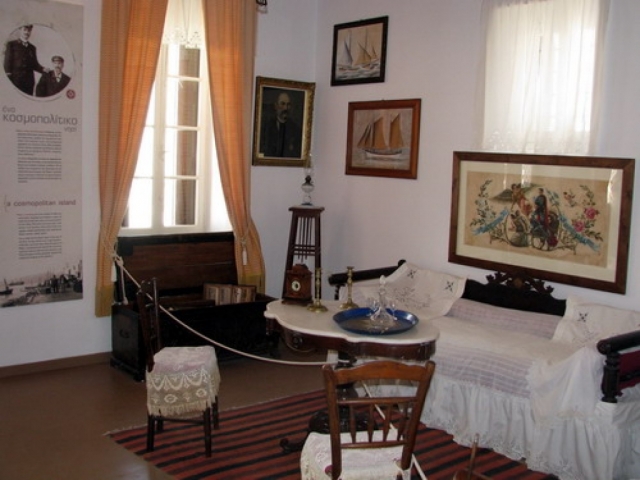

The Folklore & History Museum of Milos is located behind the church of Panaghia Korfiatissa in Plaka.
The museum was established in 1967 by the “Union of the Melians in Athens” and there you can learn a lot of things about the life of the Melians after the 17th century (mostly from 1850 up to 1930, which was a peak period for the Melian society).
A visiting to this museum takes back into another time period, as you will see how a city Melian household of the 19th century was like. The museum is not an exact representation of a certain type of a Melian household, but starting from the heterogeneous objects, the aspects of life of the inhabitants in that time period are presented: their dealings inside and outside the house, their influences from other regions, their nutritional and dress preferences, their ways of entertainment, the organizing of space and time and the exploitation of the local resources.
This two-storeyed museum is made of a living-room and the unique exhibits located in it, the work place where the loom is found, the house’s kitchen room, the bedroom, the cellar (used also for the storage of rural products), and the top-floor which constitutes a historic record. In all these rooms you can also admire furniture, textiles, needlework, clothing of that period, house ware, decorative objects, everyday objects and old photographs.
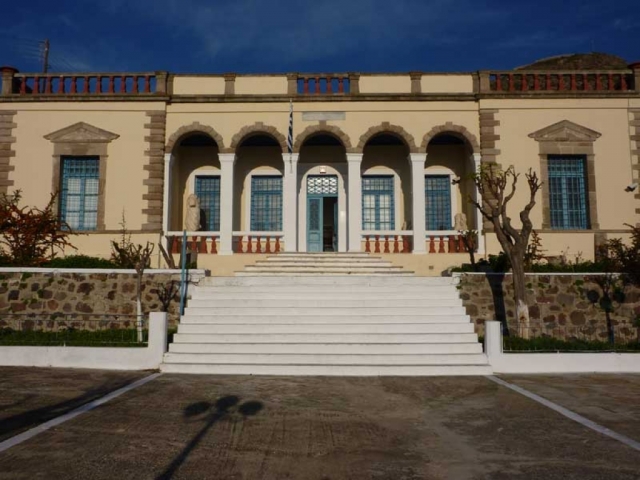
The Archaeological Museum of Milos is situated in Plaka and it is housed in a beautiful, neoclassic building by Ernst Ziller.
At the museum the following wonderful collections are exhibited:
A prehistoric collection from Fylakopi
A collection of sculptures and bas-reliefs
An obsidian collection
A collection of inscriptions
A true copy of Aphrodite de Milo rises in the Museum Entrance (Room A), which was made in the workshop of the Louvre Museum. In the left side of the room you can see glass-shown cases with blades, scales and obsidian exfoliates from Fylakopi, Nyhia and Demenegaki. Moreover, in the same room, you can see a large burial jar dated from the 6th century BC.
In the left room (Room B) you can see prehistoric objects dated from the 5th millennium till the end of the 2nd millennium BC. There, you can see glass-shown cases with archaeological findings from ancient Fylakopi, many pots with lilies painted on them , statuettes ,a tufa altar from Fylakopi’s sanctuary, a small collection of marble early Cycladic statuettes and the famous “Kyra of Fylakopi”.
In the small room behind the entrance (Room C) you can admire geometric, archaic, classic, Hellenistic and Roman works, plenty of coins, tools and handy objects.
Closing, reaching the room on the right of the entrance (Room D’), you will see findings from the ancient town of Klima, plenty of sculptures dated form the Hellenistic and Roman period (a Hermaic statue of Marius Trofimos, a tomb bas-relief of a young man with his servant etc.), marble donations and tables of the archaic Melian alphabet (Thanks to the peak the Melians had reached in the historic period, they had developed their own “Melian alphabet” composed of 21 letters).
In the north side of the church of Panaghia Korfiatissa ( just a back-street further down) you will find the second Catholic church of the island: the church of Panaghia ton Rodon or Rozaria.
This small Catholic church was built in 1823 by the French vice-consul Louis Brest (as it is written in the inscription), and inside the church Brest himself was buried and his spouse was buried in the yard. It is worth mentioning that the church’s lintel is decorated with the coat of arms of the French king Ludwig XVI .


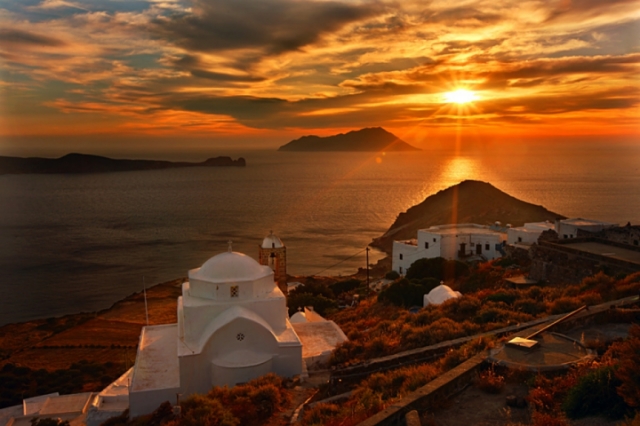

The Castle was built in the 13th century on the hill of Prophitis Ilias, on the northwest edge of the island (today’s Plaka).
Nowadays it is not inhabited, but its visitors can admire a view of incomparable beauty of the entire island bay and of the magic sunset that is worth enjoying when you decide to climb all the way to the top. Also, ascending to the Castle, you will have the chance to see the church of The Assumption of the Virgin Mary or Panaghia Skiniotissa and the church of Panaghia Thalassitra.
This Venetian Castle was not surrounded by walls, as it was the case with most of the Cycladic castles, but it was protected by the houses. Practically, the castle was used to protect the local population against the attacks of pirates (a frequent phenomenon of the era), and also for the control of the ships’ movements in Adamantas bay. On its top, the “Mesa Kastro”, the Tower of the Governor was located, the so called Palace and around the tower there were a few houses. It was established by the first duke of Naxos, Marcus Sanoudos and in the Mesa Kastro there were mainly the residencies of the Duke’s manors and deputies, as well as of other relatives and Franks.
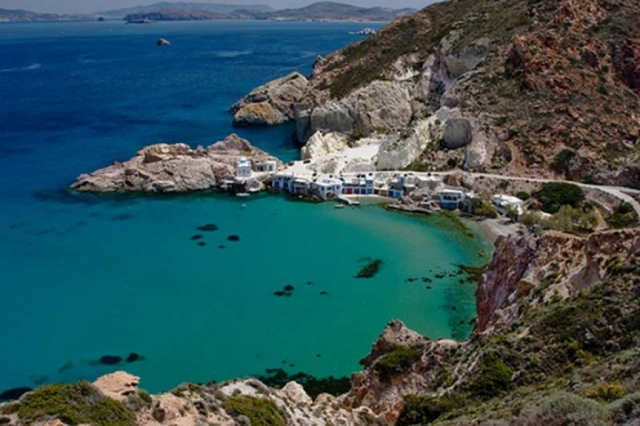
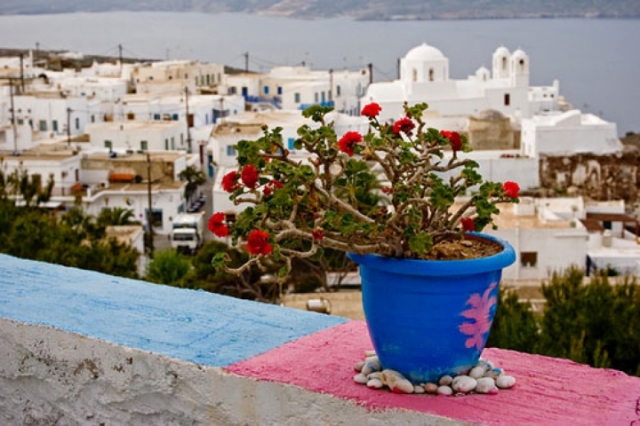

Nowadays, Plaka is the island’s capital and it is also one of the most intact capitals of Cyclades.
Its name comes from the level ground upon which the houses of its first inhabitants were built, when the Castle (Kastro) could no longer house the entire population.
Built on a hillock of 220m above sea level, with the use of island colors and according to the Cycladic architecture, with picturesque tiled alleys originally built for the protection against pirates, with small traditional shops, restaurants and cafeterias and with a magical view to the bay of Milos, Plaka composes a scenery of infinite beauty that you must visit and explore. (The circulation of cars is forbidden).
On the hill top of Plaka lies the imposing Venetian “Castle” dated from the 13th century from where you can enjoy idyllic sunsets with beautiful colors and the panoramic view to the island’s bay, as well as to neighboring Cycladic islands. The Assumption of the Virgin or else “Mesa Panaghia” is the church to be found on the top of the Castle, whereas climbing up to the Castle and descending from it, you will find another exquisite church built on a black rock: The Ypapanti of Christ or Panaghia Thalassitra. Moreover, do not miss out to visit ‘’Panaghia Korfiatissa” which is the island’s cathedral from where you can enjoy a dreamy sunset right from its marble yard.
Lastly, in the traditional settlement of Plaka, you will find most of the public services and the two museums that preserve the island’s cultural heritage, meaning its archaeological and folklore heritage.
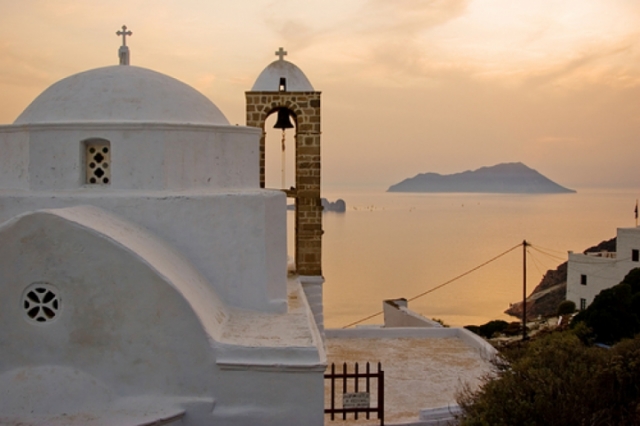
Ypapanti of Christ or Panaghia Thalassitra
The church of Ypapanti of Christ or Panaghia Thalassitra is the patron saint of sailors and it is the most multi-photographed church of the island. It is located in one of the island’s nicest spots and you will see it on your way up to the Castle. This church used to be a chapel in 1739 which was demolished in 1839 so that this magnificent bigger church would be built instead, incorporating also as a south aisle the neighboring Frankish Church dedicated to the Virgin Mary (Panaghia Eleousa).
In the church of Panaghia Thalassitra, you can see works of the 17th century made in the famous hagiographic workshop of the Skordilides, and specifically the important icons of Saint Eleftherios, the Virgin Mary and Jesus Christ, painted by Emmanuel Skordilis. Also, you can admire the woodcut icon screen with its amazing cross, whereas in the lintel of the church’s west gate you can see the coat of arms of Krispi, who was the duke of Naxos.
Birth of the Virgin Mary of Panaghia Korfiatissa
In the west side of Plaka, on craggy rocks, in 1810 the church of Panaghia Korfiatissa was built. The location is known as “Halara”, and the space in front of the church is known as “Marmara”, due to the fact that the churchyard is paved with marble tombstones from the old city.
Visiting the church dedicated to the Birth of the Virgin Mary or Panaghia Korfiatissa, apart from the wonderful view of the sea and the spectacular sunset, you can see relics from the island’s old deserted churches, Cretan-Byzantine icons from the churches of Zefyria, holy relics kept in small silver boxes, the woodcut gold-plated icon screen, as well as the gold-plated epitaph dated from 1600 from the church of Panaghia Skiniotissa, which was brought from Smyrna.


 Login with
Facebook
Login with
Facebook