



 Upload your photos for Sfontili and share them with us!
 Press here.


 Address:
Μύκονος, Ελλάδα
Address:
Μύκονος, Ελλάδα  Telephone:




Places near Sfontili

Mt. Cynthus
If you visit Delos consider hiking to this hill, you get a view of almost the entire island and a sense for how important the place was historically.

A temple dedicated, probably, to the mythic Greek goddess Tyche (meaning "luck" in Greek), who was the personification of fortune, prosperity and wealth. The Roman equivalent was the goddess Fortuna.
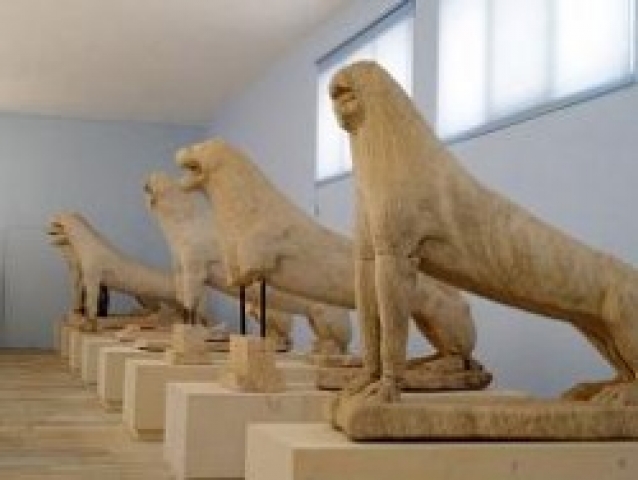

Delos Archaelogical Museum
The Delos Museum was built in 1904, with the expense of the Athens Archaeological Society. The original building included the five western rooms, plus several more in 1931 and 1972. In the same period there have been huge, but unfortunate, modifications in the appearance of the building.
The present exhibition contains nine galleries: six of them contain sculptures and reliefs found on Delos, one of the best collections in the world. Two rooms hold pottery dating to the prehistoric and late-hellenistic periods and a final room showcases the various miniature objects found in the private homes of Delos. The exhibition is not yet complete.
Collections
The most important collections include:
Statues and columns of the 7th - 1st century BC
Vases of instruments of the 3rd millennium - 1st century BC
Idols 2nd - 1st century BC
Jewelry and small items of 2nd - 1st century BC
Mosaics of 2nd - 1st century BC
Exhibits
The key exhibits include:
a plate with ivory relief of Mycenean warrior that was found in Artemision
a torso Kouros from the temple of Apollo
a marble cluster Vorrea which snaps the princess of Attica Oreithyia and was located in the temple of Athens
statues belonging to Dioskouridi and his wife, Cleopatra -- Athenians living in Delos - found at the home of the couple, in the area of theatre,
a statue of Apollo in the press of the Lyceum of Praxitelous Apollo - the god based in the trunk of a tree and clicks on Gallic shields - from the area of theatre,
a bronze facade bearded Dionysus who diadima bodies and ivy wreath and found south of the Market Kompetaliaston, Corinthian alabaster - a vase for perfumed oil with a Potnias Thiron between two swans - found in Iraio,
a headed triangular pedestal Kouros statue - with relief head crushed in a corner gorgoneia and the other two - from the Temple of Apollo,
an Archaic daughter, which is decorated in the middle of the front with vertical film debossed double meandros - found in the Temple of Apollo, and is considered one of the oldest existing large plastic,
a fresco from the outside wall of a house in the area where Skardana represented by Hercules, and two pygmachoi male form plays flute or trumpet.
Public tank, constructed to collect water from the river Inopos, the sacred river of Delos, that its springs were on the Mt. Kynthos and also believed to contact underground with the river Nile in Egypt. The water used for the ceremonies of the Egyptian sanctuaries.
In this area there are temples that are dedicated to Egyptian Gods.
Group of private dwellings, named for the seasonal stream, Inopos, one of the only ones on the island. The waters were sacred, and were supposed to flow directly from the waters of the Nile River in Egypt.
This was a Sanctuary built by Egyptian merchants, around 200 BC. It was the place of worship of the ancient Greek-Egyptian god Sarapis (or Serapis) and goddess Isida, and later Anubis and Horus, who was called by the ancient Greeks Arpokratis
It was the sanctuary of the Syrian gods, built probably around the middle of the 2nd century BC. This sanctuary was the place of worship of goddess Atargate and her partner Adas.
One of the more complete houses. Mosaics feature theatrical masks, and a stunning floor with the god Dyonysus riding on a panther
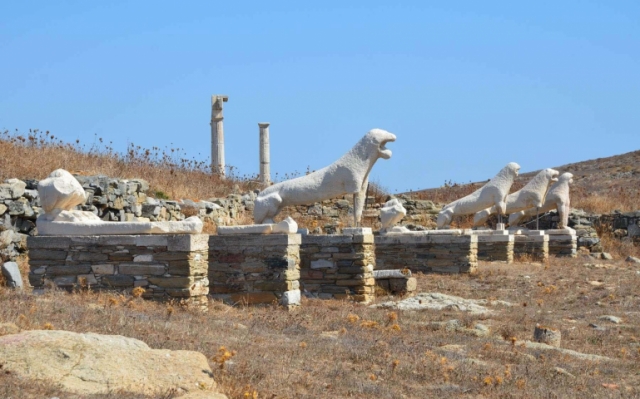

Delos is the sacred island of the Ancient Greek, which according to mythology, was revealed among the waves of the Aegean to Leto, who was being chased by the jealous Hero; it was the refuge where she gave birth to Apollo and Artemis.
On Delos the admirably well-preserved ruins of one of the largest, most significant, and best- organized ancient Greek settlements are found. The island was first settled, probably by the Kares, about the 3rd millennium B.C. In the beginning of the 8th cent. B.C. it developed into a center of worship and was the capital city of an amphictyony of Aegean island.
At the end of the 6th cent B.C., the tendency of the Athenians was to take over the island: IN 540 B.C. Peisistratos ordered the first purification of the sanctuary. As a result of the second purification (426 B.C.) the entire contents of all the islands graves were remove to neighboring Rhenia. Afterwards in order to prevent desecration of the sanctuary, both births and deaths were forbidden on the island of Apollo.
The Athenians consecrated the first “Delia” dedicated to Leto, Artemis, and Apollo. In 315 B.C., when Macedonians arrived on the island, Delos achieved its independence and developed commercially.
During the Roman period, the island thrived, until, until 88 B.C.; the population included Egyptians, Syrians and Italians. Then, after two dreadful attacks during the Mithridatic War, Delos went into decline and was finally abandoned in the 6th cent A.D.
In 1873 the French Archaeological School of Athens started excavations and restoration to help the wealth of the island's history to be revealed. The Archaeological Museum of Delos houses one of Greece’s most important collections, including rare exhibits of ancient sculpture ceramic vessels, epigraphs and wonderful mosaics etc.
The sites of Delos and Rhenia are protected by the Ministry of Culture; thus, both the mooring of private boats there and staying overnight without official permission are strictly forbidden.
How to get there
There are daily trips to Delos, as long as the weather allows (connection by sea to Delos is difficult during winter or some summer days, mainly due to extreme wind conditions). During the high season trips to Delos are available from other islands of Cyclades as well (from Tinos and Naxos mainly).

From the mid 2nd century, a small Jewish community lived on Delos, most likely traders like the other Levantine residents. This synagogue dates from sometime in the 1st century BC

This natural fissure in the rock was probably one of the oldest sites of worship on the island, dating at least back to archaic times. Symbolically, the fissure was the womb from which the goddess gave birth to life. In the 3rd century BC giant slabs of rock were added to form a roof, or replace a natural covering that collapsed. Carved into the living rock at the back of the fissure is a small platform on which a statue of Herakles once stood. Being inside here at sunset is truly a mystical experience...but don't miss your boat or you'll be spending the night
Residential and commercial area backing up the small stadium, which is the vaguely ovoid area just to the west. The stadium itself was probably built in the early 3rd century BC. Not much remains, but you can see the remains of a few tiers of seats.

Dedicated to the son of Apollo, who, legend has it, was the first king of Delos. Early 6th century BC, which makes it one of the oldest structures on the island, although nearby are the remains of tombs dating from a century earlier
A large courtyard surrounded by open rooms, dating from the early 3rd century. A structure on the north side was called the Ephebion, a gathering place where youths (epheboi) would be lectured. Or cruised, if Carystios was around. (See note for Temple of Dionysos.)
The Stadium was where all the sports events and games of Delos took place. It situated on the northeast side of the island and was built in the early 3rd century BC. But today not much remains.βαθμό.

A temple dedicated to the ancient Greek god Zeus and goddess Athena.

One of the more elaborate and well preserved private structures on Delos. Originally it featured multiple stories, set into the hillside. Two floors have been restored. It was named after the "herme" or memorial stele found inside, and probably was some sort of meeting house, rather than a private residence.

Named for the wonderfully preserved floor mosaics. Most likely built for a Phoenician trader, as one of the mosaics features the Phoenician god, Tanit, and another actually is "signed" by an artist named Askelepiades of Aradios, Aradios being a city in Phoenicia. As was typical during the Roman era, artists were important from all over the known world.


 Login with
Facebook
Login with
Facebook