



 Upload your photos for Ammoudaki Tou Kerenale and share them with us!
 Press here.


Prefecture: Cyclades
 Address:
Μύκονος 846 00, Ελλάδα
Address:
Μύκονος 846 00, Ελλάδα  Telephone:




Ammoudaki Tou Kerenale
Places near Ammoudaki Tou Kerenale


A gamma-shaped structure, situated on the southwest side of the Sanctuary of Apollo, in contact with the Propylaea.
Oikos translates roughly as "family unit," and this building was meant to connect the "family" of Naxos to the family of Apollo. The Naxians had been building temples here since the 7th century BC, but this ruin primarily dates from the 6th century and later. (If you look closely, you can see a couple of holes in the exposed bedrock within the courtyard. These would have held the original wooden columns of the first building.) The Oikos was most famous for its huge statue of Apollo, nearly 8 meters tall, which tumbled over in a huge storm sometime in the 4th century BC. Although it was later re-erected, time, pirates, and the elements have reduced it to a couple of very worn lumps of brilliant white marble.
One of the three temples of Apollo, built by the Athenians and specifically by Peisistratos around 530-510 BC. The temple was housing a statue of Apollo. It is the oldest of the three temples of Apollo.
in this house they found the headless statues of the owners, Dioskourides and his wife Cleopatra, a couple from Athens; they were erected in 138 BC by Cleopatra after the death of her husband; French archaeologists chose to name the house after her, a decision which increases the number of visitors, but disappoints those of them who believed there was a link between the location and Cleopatra VII, the famous Egyptian queen. Cleopatra is a Greek name meaning "glory of her father".
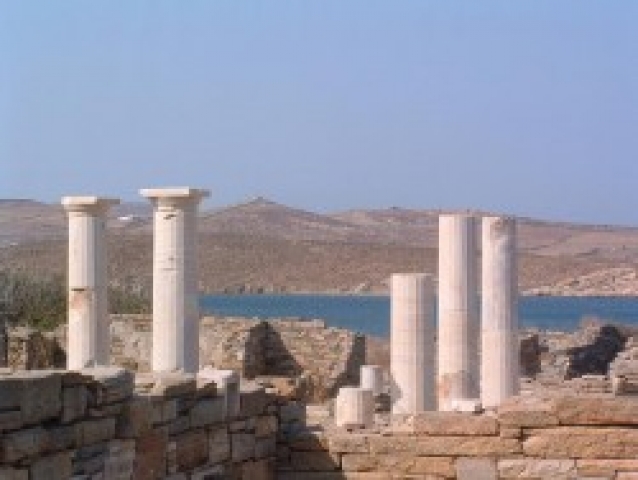
On the left from the harbor is the Agora of the Competialists (circa 150 BC), members of Roman guilds, mostly freedmen and slaves from Sicily who worked for Italian traders. They worshiped the Lares Competales, the Roman "crossroads" gods; in Greek they were known as Hermaistai, after the god Hermes, protector of merchants and the crossroads.
Agora of the Competialists, an open yard, surrounded by shops, small temples and altars, is the first monument that the visitors see, entering the archaeological site of Delos. Here were the stores of the merchants of the association of Roman citizens and liberalized slaves, who worshiped the gods of the "crossroads", the Lares Competales. However, the market served also other traders, Hermaists and Apolloniasts.

This temple of Apollo is chronologically the second one that was built in the sanctuary. Tough to imagine, but this humble pile of rubble used to be one of the more impressive monuments on the island. Started by the Athenians when they controlled Delos, sometime around 475 BC, it wasn't finished for another hundred years or so.
The monumental gateway leading to the sacred precinct of Apollo. The version that survives (basically just the massive marble platform and a few doric column stumps) was built by the Athenians when they still controlled the island--with tacit approval from the Romans--in the 2nd century BC.
It is located on the west side of the Sacred Way and was a commercial arcade with many shops. It was constructed by the Greek King Philippos V of Macedonia.
A temple dedicated to the ancient Greek god Apollo, also being invoked as Pythios (Pythian Apollo), an epithet due to his association with the site of the Delphic oracle.
A temple dedicated to ancient Greek goddess Demeter, also being invoked as Thesmophoros.


Excavations have unearthed the spectacular 3rd- to 5th-century mosaics of the Houses of Dionysus.
Built by the Athenians between 425-417 BC, it is the most elaborate of the three temples of Apollo and the official temple of the Athenian Alliance.
Ecclesiasterio (Ecclesia) was the place where the Citizens' Assembly of Delos, took place.


A sanctuary dedicated to the Twelve Olympians, the principal gods and goddesses of the Greek pantheon, of ancient Greek mythology, also known as the Dodekatheon (means "Twelve gods" in Greek).
Southern Stoa was built by the kings of Pergamon, in Asia Minor, in the early 3rd century BC. It is located on the east side of the Sacred Way and was a commercial arcade with many shops.


 Login with
Facebook
Login with
Facebook