



 Upload your photos for Kato Vardia and share them with us!
 Press here.


 Address:
Δήλος
Address:
Δήλος  Telephone:




Places near Kato Vardia

Mt. Cynthus
If you visit Delos consider hiking to this hill, you get a view of almost the entire island and a sense for how important the place was historically.

A temple dedicated, probably, to the mythic Greek goddess Tyche (meaning "luck" in Greek), who was the personification of fortune, prosperity and wealth. The Roman equivalent was the goddess Fortuna.
One of the more complete houses. Mosaics feature theatrical masks, and a stunning floor with the god Dyonysus riding on a panther
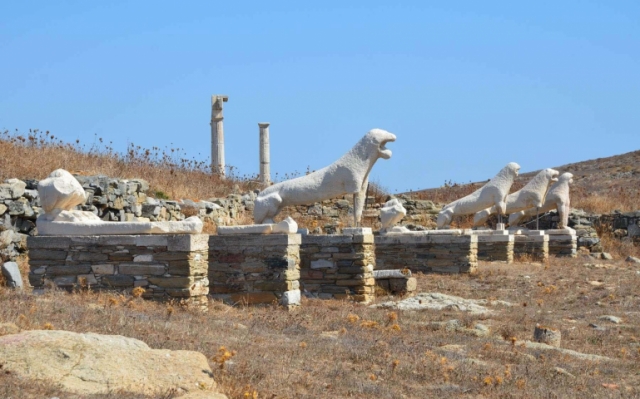

Delos is the sacred island of the Ancient Greek, which according to mythology, was revealed among the waves of the Aegean to Leto, who was being chased by the jealous Hero; it was the refuge where she gave birth to Apollo and Artemis.
On Delos the admirably well-preserved ruins of one of the largest, most significant, and best- organized ancient Greek settlements are found. The island was first settled, probably by the Kares, about the 3rd millennium B.C. In the beginning of the 8th cent. B.C. it developed into a center of worship and was the capital city of an amphictyony of Aegean island.
At the end of the 6th cent B.C., the tendency of the Athenians was to take over the island: IN 540 B.C. Peisistratos ordered the first purification of the sanctuary. As a result of the second purification (426 B.C.) the entire contents of all the islands graves were remove to neighboring Rhenia. Afterwards in order to prevent desecration of the sanctuary, both births and deaths were forbidden on the island of Apollo.
The Athenians consecrated the first “Delia” dedicated to Leto, Artemis, and Apollo. In 315 B.C., when Macedonians arrived on the island, Delos achieved its independence and developed commercially.
During the Roman period, the island thrived, until, until 88 B.C.; the population included Egyptians, Syrians and Italians. Then, after two dreadful attacks during the Mithridatic War, Delos went into decline and was finally abandoned in the 6th cent A.D.
In 1873 the French Archaeological School of Athens started excavations and restoration to help the wealth of the island's history to be revealed. The Archaeological Museum of Delos houses one of Greece’s most important collections, including rare exhibits of ancient sculpture ceramic vessels, epigraphs and wonderful mosaics etc.
The sites of Delos and Rhenia are protected by the Ministry of Culture; thus, both the mooring of private boats there and staying overnight without official permission are strictly forbidden.
How to get there
There are daily trips to Delos, as long as the weather allows (connection by sea to Delos is difficult during winter or some summer days, mainly due to extreme wind conditions). During the high season trips to Delos are available from other islands of Cyclades as well (from Tinos and Naxos mainly).

This natural fissure in the rock was probably one of the oldest sites of worship on the island, dating at least back to archaic times. Symbolically, the fissure was the womb from which the goddess gave birth to life. In the 3rd century BC giant slabs of rock were added to form a roof, or replace a natural covering that collapsed. Carved into the living rock at the back of the fissure is a small platform on which a statue of Herakles once stood. Being inside here at sunset is truly a mystical experience...but don't miss your boat or you'll be spending the night
A temple dedicated to the ancient Greek god Zeus and goddess Athena.

Named for the wonderfully preserved floor mosaics. Most likely built for a Phoenician trader, as one of the mosaics features the Phoenician god, Tanit, and another actually is "signed" by an artist named Askelepiades of Aradios, Aradios being a city in Phoenicia. As was typical during the Roman era, artists were important from all over the known world.


 Login with
Facebook
Login with
Facebook