



 Upload your photos for Church and share them with us!
 Press here.


 Address:
Κρυονερίδα
Address:
Κρυονερίδα  Telephone:




Places near Church


Vrisses has only been in existence since 1925, yet is a very typical and traditional working / farming village. Set on the Vryssano River, which has lovely, shady Plane trees on its banks, and tavernas and cafes under the trees.
Perfectly situated between Chania and Rethymnon (about 30 minutes drive to either), and on the road that leads over the foothills to the Imbros Gorge (about 30 minutes drive) and to Chora Sfakion on the south coast (about 45 minutes drive).
Vrisses is surrounded by many quaint hamlets, and is the perfect starting point for discovering many different areas of Crete. Famous for its delicious yoghurt and honey, the village itself has tavernas, kafenion, 2 bakeries, a butcher, 2 super markets, a bank, 2 petrol stations, a pharmacy, as well as other shops. Direct access to the National Highway, 5 minutes by car to Vamos, 8 minutes to Georgioupolis, and 15 minutes to Kalives.
Vrisses village in Apokoronas, Chania, West Crete Vrisses village in Apokoronas, Chania, West Crete Vrisses village in Apokoronas, Chania, West Crete Vrisses village in Apokoronas, Chania, West Crete Vrisses village in Apokoronas, Chania, West Crete Vrisses village in Apokoronas, Chania, West Crete Vrisses village in Apokoronas, Chania, West Crete Vrisses village in Apokoronas, Chania, West Crete
The Elliniki Kamara bridge
At the junction of the road from Vrisses, to the national main road (Hania - Rethimno), at the exit to Rethymno city, there is the historical landmark of Vrisses (Exact location: 35.369062,24.215299): The “Elliniki Kamara”, a bridge upon Vrissanos River that dates from the Greco-Roman era. The bridge is in use even today, and is made from stones, which are fit together side by side without the use of mud, or any other substance to hold them together. Its height is about 6,5 metres.
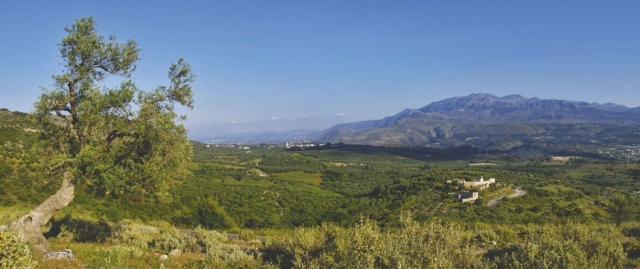

On the Apokoronas peninsula (Chania)- half-way between Vamos and Vrysses - stands an Agios Georgios monastery also known as the Karydi monastery. The first pieces of information about the monastery come from a report from the Venetian governor Francesco Barozzi to the Venetian senate in 1577 where he mentions the village of Caridhi San Zorgi. Some years later another Venetian official mentions that the village of Caridi S(an) Zorzi owes 30 services of serfdom.
The Egyptian census from 1834 states that the village consisted of six Christian and three Turkish families. The monastery had its great period at the same time as it had obtained a licence to produce olive oil in 1829. The oil production gave employment to many of the inhabitants in the area and for that reason the large hall with the six oil mills was built in 1860. The monastery was not mentioned in the following censuses because it had been placed under the Agia Triada monastery on Akrotiri.
The inhabitants of the area had according to tradition converted to Islam - more or less voluntarily - except the abbot of the monastery. When the Turkish authorities of the area threatened to convert the monastery into a mosque the abbot handed over the monastery to
Agia Triada which was placed under the patriarchate of Constantinople and therefore, according to Turkish law, inviolable.The village of Karydi was mentioned separately for the last time in the census of 1928 where it belonged under the rural district of
Vamos and had 31 inhabitants.
After having been uninhabited since 1900 the monastery was officially closed down in 1923 and its lands distributed among veterans from the Balkan Wars and from the unsuccessful expedition in Asia Minor. At the request of Eirinaios Galanakis, the just retired metropolitan of Kissamos and Selino (24th of August 2005), the monastery was reinstituted in 1996.
Today it is headed by prior Dorotheos who has worked hard - and still does - to renovate the old monastery.
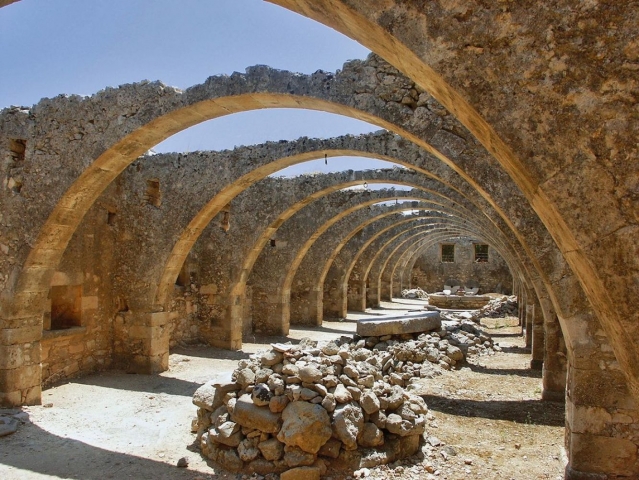

Boutakas river is located in Chania and with the concourse of Vrissianos river crossing the village Vrisses Apokoronou.
Waters of the river emanating between the villages Emprosnero and Vafe and the water comes from the melting snow of Madares. The river's name comes from the greek verb "mpaino" that means go in.


 Login with
Facebook
Login with
Facebook