



 Upload your photos for Church and share them with us!
 Press here.


 Address:
Νεροκουρος
Address:
Νεροκουρος  Telephone:




Places near Church

Tsikalaria is built amphitheatrically at the foot of the mountain "Malaxa" and consists of the districts of "Tsikalaria", "Ag. Foteini", "Alona" and "Metohia". There are many theories about the origin of name of the village. The most dominant assigns the name "tsikalaria" to the clay-made pots, which used to be a local product. Until a few years ago, there were still remains from the clay factories in the region. According to tradition, technicians from the region migrated to the island of Sifnos and transmitted there the art of clay. Furthermore, according to tradition, the village of "Tsikalaria" was also known as "Arhontohori".
The name of the "Metohia" district originated from the names of the first Turkish rulers, who lived there and built their villas, still preserved today. The name of the village "Ag. Foteini" originated from the church of St. Foteini, which still exists and was a former monastery. At the village's center, there is a preserved Turkish mosque, which was formerly a church dedicated to St. Nicolas.
The central spring water fountain of the village is located at the mosque, which was used by the Turks for cleansing themselves before entering the mosque. At the entrance of the mosque there is also a well preserved Turkish coffee shop.
The church of St. Antoine is a remarkable attraction for visitors, with its recently renovated bell tower and its imposing entrance, built on a panoramic location. To the west, the famous Byzantine church of Virgin Mary is located, with its beautiful 16th-17th century cupola.
In the district of "Alona" (Turkish fortress) there is a deep well, where many local revolutionaries were thrown to their death by the Turks. The revolutionaries themselves were forced to dig and construct this well.
The district of "Metohia is still inhabited by the descendants of refuges from Asia Minor who came to Crete with the population exchange that took place between Greece and Turkey, after the tragedy in Asia Minor. These refuges brought with them unique cultural traditions of Asia Minor, blending it with local traditions. In "Metohia" there is the church of St. John "the Rigologos".
Every year in Tsikalaria, many cultural events and festivals are organized by the local Cultural Organization. The most important are:
The St. Antoine festival
The St. John "the Rigologos" festival
The "rosewater festival" in spring, is a festivity that revives the traditional way of producing rosewater.


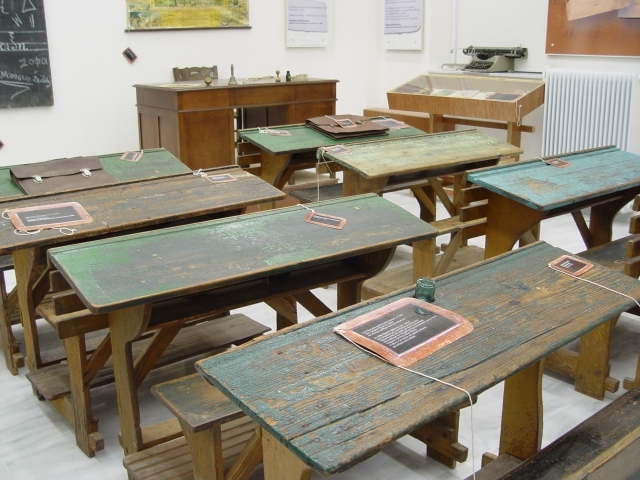

The Museum of School Life is a center of culture that focuses on the educational and pedagogic practice of past, present and future. The museum is located in the area of Nerokourou in Chania and hosts all those elements that characterized the school life of past, such as documents, various objects, supervisory means of teaching etc.
Primary aim of the Museum of School Life is the research of the educational and school past in all periods of the local and, more generally, Cretan History, the scientific analysis, recording and protection of it, its connection with the current educational reality and its needs, as well as its projection as a important parameter of influence for the future of Education.


 Login with
Facebook
Login with
Facebook