



 Upload your photos for Καρές and share them with us!
 Press here.


 Address:
Αρμένοι
Address:
Αρμένοι  Telephone:




Places near Καρές
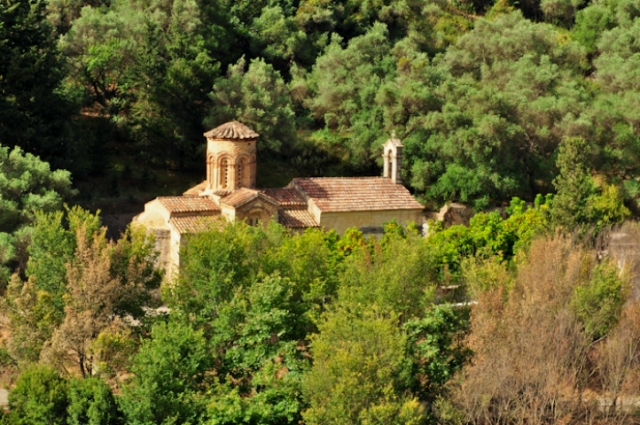

The Byzantine church of Saint Nicholas is located in the small village of Kyriakoselia Apokoronou.
It’s been regarded as one of the finest and most important Byzantine churches on the island of Crete, dating back to the 11th century!
Beautiful Byzantine murals of the 13th century are been preserved on the walls, in the interior of the church, in shades of "Egyptian Blue". The scenes that stand out are the ones from the Christological cycle, the life of Virgin Mary and the life of St. Nicholas. A group of painters decorated the interior using the technique of fresco and intense, luxurious colors.
Originally it was a single-nave church, vaulted with a dome, while the Venetians transformed it to a cross-shaped church. It is built on the foot of the hill on which stands the fortress of Kastelli, which was an entry control point to Souda Bay. Outside the church is the cemetery of the village, a sacred place for the locals, full of sour orange trees.
To visit the Church of St. Nicholas, you have to follow the road from Kalives to Nio Horio and turn right to Stylos. Then you have to turn left following the signs to Kyriakoselia, a total distance of fourteen kilometers from Kalives. The route is really beautiful in a landscape full of rich vegetation and the view from above to the valley and the magnificent sea is magical. In order to admire the interior of the church you need to visit the local cafe of the village and someone will open the church for you.
Visiting Agios Nikolaos is a unique opportunity to explore the surrounding villages, which are considered as most authentic and with minimum deterioration from tourism and development.
Definitely something different and unique!


A beautiful tranquil village in the foothills of the White Mountains, by Chania Prefecture, West Crete - 450m height above sea level. Here there are two sleepy village coffee shops where nothing has changed since the 50’s except the television.
The elderly play cards, talk about their sheep, and await their grandchildren to come for the weekend. Old Cretan hospitality is found here. A new, recommended tavern-restaurant is open every evening, offering authentic local cuisine and the best dairy products.
Distances:
A short drive downhill from Melidoni brings you to the picturesque – and protected – regional village of Fres (3 km). Here you will find a bakery, shops for all your daily requirements, and good tavernas. More sophisticated shopping can be done at the large central villages of Vamos 11 km (health centre) and Vryses, (10km) where you will find banks, a chemist, doctors, restaurants and shops for all your needs. Kalives 12 km offer the nearest beach: Kyani akti and together with Almyrida are a large tourist center.
A six-kilometre drive from Melidoni down well-surfaced secondary roads brings you to the National Highway.
Times and distances from Melidoni to:
Melidoni is 6 km from the National Highway (8 minutes). From the junction:
Chania (city centre) is 24 km away (15-20 min) Rethymnon is 40 km away (35 min)
The times are calculated using average speeds and light traffic.
The village of Kyriakosellia is located in the district of Ramni, by Chania Prefecture, West Crete, preserving the traditional Cretan architecture to a large degree.
Preserved there is the temple of St. Nicolas, one of the most beautiful Byzantine churches of Crete, built in the 11th century and decorated with valuable wall paintings, restored to a very good condition. Nearby the village there is a cave with the painting of St. Mamas, as well as a Byzantine fortress in Kastelli. In the area visitors can also see the ruins of an old settlement and a small "koules" (Venetian fortress). Finally, there are caves in the area, including the cave "Pontikospilo".
Madaro is mountain village, between Thimia and Melidoni village and belongs to Keramies Municipality, in the foothills of the North White Mountains, by Chania Prefecture, West Crete. The road which goes to Volika shelter passes through Madaro.
The oldest refuge in Lefka Ori is Volika at an altitude of 1450 meters above the sea level and was built in 1958. In 2006 it was fully renovated and can accommodate 30 people. The route from the village along the footpath takes about 3 hours, but the recently completed rural road from Madaro now reaches a point which is only 10 minutes away from the shelter


 Login with
Facebook
Login with
Facebook