



 Upload your photos for Church and share them with us!
 Press here.


 Address:
Μεσήσκλιο
Address:
Μεσήσκλιο  Telephone:




Places near Church


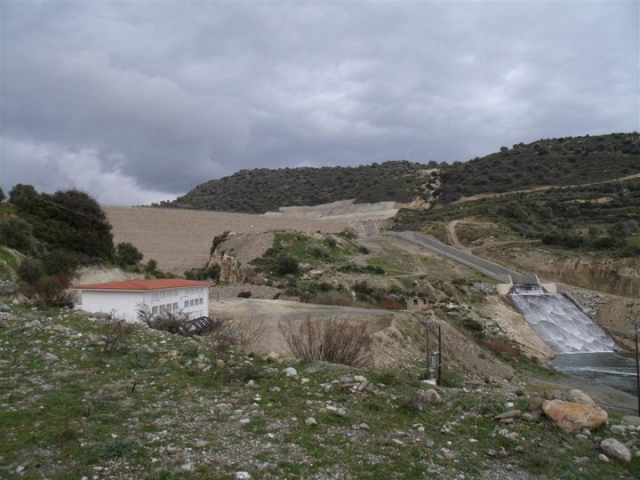

For this reason, the construction of a second dam in the neighbouring Watershed of Platys is under way. According to the designs, a pipeline will carry water from Platys to Faneromeni Dam in order to increase the inflow and replenish the resources of the latter (personal communication with M. Kritsotakis). The Faneromeni Dam has been constructed to cover irrigation demand through an extensive irrigation pipe network. Currently, the irrigation system covers only part of the required area.
Description of problemExperts assess that the Messara Valley is threatened with desertification. Numbers shows evidence of the dramatic drop of more than 30m in the mean groundwater level during the period 1989-2002. The depletion of the aquifer has reduced water availability as groundwater is a major resource for irrigation. The causes can be traced to the uncontrolled pumping and use and has created tension amongst the users. The groundwater level dropdown started with the introduction of pumping of the groundwater store for drip-irrigation of the main crop which is olive trees.
It should be underlined that the limiting factor of water sufficiency is not the average precipitation availability. Local and seasonal variations that occur throughout Crete have greater significance with respect to demand and supply. About 70 – 80% of the annual precipitation depth occurs within three or four months whereas the summers are extremely dry and long.
This condition is intensified by the local and seasonal variations of water demand. Agriculture and tourism demand increasing amounts of freshwater late in spring, during the summer and in early fall when water resources are more scarce. Moreover, domestic water use increases during the warmer and drier season. On average, Crete has a low per capita water sufficiency, about 4800m3/inhabitants per year, which is the lowest in Greece (average of 6700m3/ inhabitants per year) (Chartzoulakis, 2001).
The impact of groundwater abstraction on the ecosystem of the Watershed became obvious when the springs in the surrounding hills dried up and the environment around these springs died, with the loss of birds, small animals and flowers. The wetlands of the Messara Plain were once known for the large number of waterfowl and wild ducks. The Geropotamos stream was known for its large eel population, and its banks for their significant wild rabbit and hare populations. These populations are now almost extinct, partly due to the drying up of the wetlands and partly due to agricultural pesticide poisoning.
The Messara valley is a typical graben, formation of parallel system of faults with an east-west direction. Steep mountains rise on the north and south sides. To the north, the divide varies from 2200 m to 600 m from west to east, with the highest point being part of the Ida mountain range (peak at 2540m) which is a limestone massif. To the south is the Asterousia mountain chain which rises 600m in the west to 1200m in the east and constitutes the southern most mountain range of Europe. At the Phaistos constriction in the west, the catchment outlet of the Geropotamos River is at 30 m above sea level (ASL). The Plain is covered mainly by Quarternary alluvial clays, silts, sands and gravels with thickness from a few metres up to 100 m. The inhomogeneity of the plain’s deposits give rise to great variations in the hydrogeologic conditions even over small distances. The northern slopes are mainly siltymarly Neogene formations while the southern slopes are mainly schists and limestone Mesozoic formations.
The Geropotamos hydrological year may be divided into a wet and dry season. About 40% of precipitation occurs in the months of December and January while from June to August there is negligible rainfall. This poses a problem since pumping for irrigation purposes follows the reverse pattern, thus stressing the aquifer. Although the Valley receives on average (long-term) about 700 mm of rainfall per year it is estimated that about 65% is lost to evapotranspiration, 10% as runoff to sea and only 25% goes to recharging the groundwater store.
Rainfall increases with elevation from about 500 mm on the Plain to about 800 mm on the basin slopes while on the Ida massif the annual precipitation is about 2000 mm and on the Asterousian mountains it is 1100 mm. Pan evaporation is estimated at 1500±300 mm per year while the winds are mainly north-westerly. The potential evaporation is estimated at 1300 mm per year and so the ratio of mean annual rainfall to potential evaporation for the Valley is about 0.5 and hence it is classified as dry sub-humid according to UNCED (UNCED, 1994)) definitions. The average winter temperature is 12°C while for summer it is 28°C. Relative humidity in winter is about 70% while in summer it is about 60%. The Plain contains several aquifers and aquicludes of complex distribution and properties.
Groundwater levels are at their maximum in March or April with long recessions until recharge occurs in winter. The aquifers were high yielding with discharge rates as high as 300 m3/hr in the early seventies but now are reduced to about one tenth of this. From pumping tests, the specific yield (S) ranges between 5⋅10-2 and 15⋅10-2 while the horizontal Transmissivity (T) ranges between 1.7⋅10-2 and 6.9⋅10-5m2/s. Lateral groundwater outflow from the Valley is small compared with the vertical groundwater outflow.
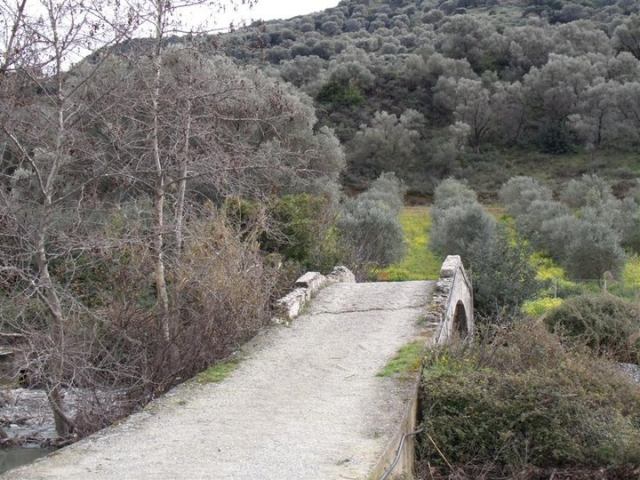

The Varsamonerou Monastery lies in the surrounding fields of the village Voriza, 54.5 kms from Heraklion City. The monastery is abandoned and, though its cells have been destroyed, its church has some of the most remarkable wall paintings in Crete. These paintings show the high artistic level of the different schools in 15th century Crete.Nowadays the church is known as Agios (Saint) Fanourios but it is also dedicated to Our Lady of the Way and to Saint John: through the years, several extensions were added to the original nave.
The oldest section of the church, dedicated to Our Lady of the Way, has wall paintings that date back to the 14th century. This north nave contains, among others, the outstanding representations of Saint John from Damas, Saint Onoufrios and the Dormition; in the south -and more recent nave- dedicated to Saint John the Forerunner, one can admire several scenes from the Passion (The Entrance to Jerusalem, the Last Supper, the Treason of Judas), the Crucifixion and the Epitaph.
The arch and eastern section of the church are from the 15th century (1400-1407).
All these wall paintings form an important part of the Cretan heritage during the first centuries of Venetian rule. In the Varsamonerou Monastery there were other remarkable icons, painted by the famous artist Angelos, and the beautifully carved iconostasis of the monastery is now in the Historical Museum of Crete, in Heraklion. This iconostasis is an outstanding example of religious art.The monastery, famous for all the art representations it possessed, was also known for its studies: a great number of books were to be found in its library. Not only religious books but ancient Greek texts as well: a catalogue, dating back to 1644, gives us the names of several philosophical treaties by such writers as Xenophon, Eschynis, Plutarch, etc.The monastery was abandoned at the beginning of the 18th century.


 Login with
Facebook
Login with
Facebook