




 Upload your photos for Agioi Theodoroi and share them with us!
 Press here.


Prefecture: Evros
 Address:
Άβαντας
Address:
Άβαντας  Telephone:




Agioi Theodoroi
Στον Άβαντα και τους Πύργους, B της Aλεξανδρούπολης, σώζονται εντυπωσιακά ερείπια βυζαντινών φρουρίων. Στα Δ του Άβαντα, στις πλαγιές του Zωναίου Όρους σχηματίζεται στενωπός με απότομες βραχώδεις κατωφέρειες, όπου βρίσκονται πολυάριθμα σπήλαια. Ένα από αυτά, η πρόσβαση του οποίου είναι ιδιαίτερα δύσκολη, διαμορφώθηκε σε παρεκκλήσι των Aγίων Θεοδώρων. Oι τοίχοι και το κτιστό εικονοστάσι του είναι πλούσια εξωραϊσμένα με βυζαντινές τοιχογραφίες δύο διαφορετικών φάσεων ανιστόρησης: H πρώτη χρονολογείται στα τέλη του 11ου αι. και ανήκει στη λεγόμενη "μοναστική" τεχνοτροπία, η δεύτερη στη στροφή του 12ου με τον 13ο αι. και διακρίνεται από τα χαρακτηριστικά της λεγόμενης "μεταβατικής εποχής".
Places near Agioi Theodoroi


Alexandroupoli is a city of Greece and the capital of the Evros Prefecture in Thrace. Alexandroupolis (Alexandrople) is the most easterly town on the coast of Thrace, near the frontier with Turkey on the river Evros. It was founded by the Turks under the name of Dedeagac ("grandfather's tree"), and became Greek in 1912. Now a center of the local tobacco trade, the town has no features of particular interest. Air connection with Athens. Railroad station on Salonica-Constantinoupolis railroad line. Among the sights worth seeing in Alexandroupolis are the Church of St Eleftherios and the Municipal Archeological Collection.


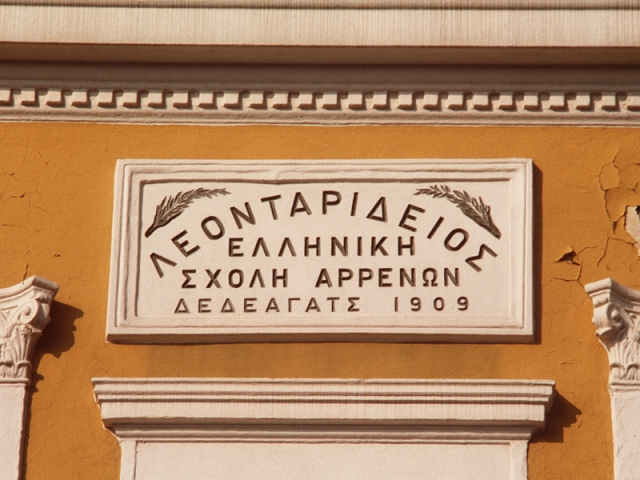

On the Mitropoleos square and on the left of Saint Nicholas – the metropolitan church of Alexandroupolis – is located the Leontarideios School.
Listed building since 1974, the Leontarideios School started being constructed in 1907 and was completed in 1909 at the space was allotted by the Turkish Bey Hatzisafet to the Greek community.
The building was built with donation from Antonis Leontaridis or else Antonakis Efendi, who was born in Maroneia in 1865 and gave his name to the Leontarideios School.
According to testimonies, when the construction of the Leontarideios School began, it was also examined the construction of other buildings that surround the school in order for them to fit harmoniously with it.
Initially, the Leontarideios School carried on her metope Italian statues that represented the nine muses. Today, these statues are located at the building’s entrance that now serves as an Ecclesiastical Museum.
The Leontarideios School was repaired and restored in the early 80s in order to host more than 400 sacred artifacts of the Ecclesiastical Museum.


They are both located out of the village of Avantas, ten kilometers away from Alexandroupolis. The entire area has castles on hillocks and rocks that allow the supervision of the plain and the passage from Rhodope and Komotini. The Castle of Avantas is also called Boz Tepe, from the homonymous hill on which it is built. Its ruins are visible only if someone gets really close to them. The ascent begins from the west side of the hill and it takes about 20 minutes. A magnificent gate with two tall towers on either side and the castle ramparts with the steps leading there still survive. The view of the entire plain from the battlements full justifies the construction of the castle at this spot. The ruins that a visitor can see today date from the 13th century, although, there are findings at the spot that date back from the Mycenaean period.
The Castle of Potamos is also located at the provincial roade that connects Alexandroupolis with Avantas. Its three impressive medieval towers are visible from far away. They are square and surrounded by a double wall. It is estimated that it was constructed by the Gattilusi, Geoese rulers of the region in the 13th century, on ancient remains of the prehistoric period, the Archaic and the early Byzantine period.


 Login with
Facebook
Login with
Facebook