



 Upload your photos for Paximadi and share them with us!
 Press here.


 Address:
 Telephone:




Places near Paximadi


Crete is still pushing for Knossos (8km south from Iraklion) to be a UNESCO World Heritage Site, and is now preparing a new folder titled Minoan civilization, which will include the most important monuments on the island, such as Phaistos, Zakros and the archaeological site of Malia, with Knossos dominating the list.
Competent authorities who are editing the file with the code name Minoan civilization, estimate that this project could pave the way for including Knossos on the UNESCO world heritage list. The construction problems identified around the area of the Minoan palace that impede the monument’s inclusion might be minor matters since the file will not focus only on the palace, but also on all the monuments of the Minoan civilization.
The unification of the wider archaeological site of Knossos and Messara is a pilot program for the creation of a Cretan archaeological sites network which is also the first step to promote the claim to be included in the World Heritage of UNESCO. This was noted during a meeting between the local governor, Stavros Arnaoutakis and deputy governor of Heraklion, Euripides Koukiadakis. The men signed two major contracts on studying the process concerning the inclusion of the broader archaeological sites of Knossos and Messara.
The first contract refers to Unification of Archaeological sites of Knossos, Karteros, Archanes, and the second one refers to the study, Unification of Archaeological Sites Messara – Phaistos, Gortyna, Agia Triada, Kommos etc.
The Labyrinth
IF THE WORD ‘labyrinth’ does not lead us eventually back to the very earliest human communities, it has a good try. The Greek labyrinthos appears to be a linguistic echo from Egypt and Asia Minor. It is possible that it relates to labrys, a double-edged axe, emblem of the Cretan royal family. No one is certain, since tracing the origin of the word ‘labyrinth’ is itself an etymological labyrinth. It creeps into something like modern English as laboryntus in Chaucer’s House of Fame and has become by the early fifteenth century laberynthe, a maze. Except for specialised usages the terms ‘maze’ and ‘labyrinth’ then become almost indistinguishable in English. Fanshawe’s seventeenth-century Horatian translations talk about clews and mazes, so we are back with the Cretan labyrinth and Ariadne’s bobbined thread, which permitted Theseus to find his way out of the maze after he had executed his monster. Such a thread was a clew, or ball of yarn, providing us with our modern word ‘clue’.THE SENSE INITIALLY was of a structure designed to baffle and disorientate; to prevent curiosity; to hide that which must not be found, either because it was sacred or because it was shameful. It may not always be a minotaur in there (and see below), but there will be something whose immediate disclosure is either undesirable or forbidden. It could be a monster, a priest or a crocodile. The secondary sense is of any structure or series of structures which, whatever their primary purpose, have the effect of baffling us as we try to find our bearings. Instead of finding our route, we stand amazed. ‘Amazed’ caught on quickly and stayed; ‘labyrinthed’ was introduced, but never won through – it sounds too clumsy. ‘Amazement’ worked well, though in modern usage we are more likely to say ‘labyrinthine’ than ‘mazy’; three centuries back, it would have been the other way around. And then there are the mazes and labyrinths whose function is purely ludic and recreational, whether in Versailles or Hampton Court. These are structures designed for those with time on their hands, time to get lost during luxurious and lengthy afternoons.What are the earliest known sightings? The first structure known to be entitled labyrinth was a vast building in Northern Egypt, constructed some time around 2000 BCE. Herodotus was astounded by it. It had been built at a vast expense of human labour, just above Lake Moeris, opposite Crocodipolis. There were fifteen hundred rooms on the top floor, according to Herodotus, and fifteen hundred below. The lower ones he was not permitted to visit, since they contained the tombs of kings and sacred crocodiles. A later traveller, Strabo, appears to confirm much of what the frequently unreliable Herodotus says, and describes the Egyptian labyrinth as a work equal in scope to the pyramids. There was a sacred crocodile in the lake, which was tame and came whenever called. It was fed flesh, honey and wine. Pliny too confirms that Egyptian labyrinths were the ‘most stupendous’ works ever constructed.The Romans built a village over the site, using the labyrinth itself as a quarry for the purpose. Others, including Louis XIV’s Antiquary, came much later and noted the sad state of the ruins that remained. Flinders Petrie identified the actual site with accuracy in 1888. It appeared that it might well have been intended, like so many other grand buildings in Egypt, as a sepulchral monument, probably for King Amenemhat III, whose mummified remains, together with those of his daughter Sebekneferu, were entombed in a nearby pyramid.BUT THE LABYRINTH which has come to us in legend and myth, and from which we take the name, is of course the Cretan one. King Minos had a son named Androgeos who went travelling in Attica, and was treacherously slain by the inhabitants of that region. Minos imposed a dire penalty. The Athenians had to send seven youths and seven maidens every nine years to Knossos. These would then be inserted, one by one, into the labyrinth, the bafflingly complex structure erected by that technological genius, Daedalus. He had built this fearsome edifice, not for pleasure or even wonder, but for incarceration. The wife of Minos, Queen Pasiphae, had copulated with a beautiful white bull and brought forth the miscegenated hybrid, the minotaur, which had a man’s body but a bull’s head, and which was characterised by fearful strength and even more fearful appetites.Theseus was the son of the King of Athens, Aegeus, and offered to become one of the fourteen votive offerings to the minotaur on the next marine consignment. He would then devise a means of killing the troublesome and ravenous therianthrope. Reluctantly, the King complied, insisting that Theseus should show that he was victorious on his return journey by changing the black sail on his boat to white.On his arrival in Crete, Theseus was helped by Ariadne to kill her half-brother. She had fallen in love with this foreign prince at first glance; a goddess was imposing her curse here, as so often. The thread she supplied let him find his way out of the labyrinth after the killing. She had asked only that he take her away with him after his heroic deeds were completed. She had, after all, just arranged the assassination of her half-brother. He did take her away, but abandoned her on Naxos, the first island the sailors came to after Crete. At Delos the sailors performed a notable dance called the Crane Dance, in which they re-threaded their way through the labyrinth in ritual form. This dance was performed by the islanders for thousands of years after Theseus’s departure. There seems to have been a fair amount of revelry on board – and presumably a few jokes about the lovelorn Ariadne whom the skipper had so casually dumped – and on their approach to the mainland Theseus forgot to change the black sail to white. His father Aegeus, watching from the cliff, assumed he had lost his beloved son to the monster, and threw himself into the sea, thereby giving it the name it still holds: the Aegean.This is the legend. From the beginning there were alternative accounts. Philochorus insisted the labyrinth was no more than a run-of-the-mill dungeon. The youths were kept there until they could be awarded to victors in the sports held in honour of Minos’s murdered son. The minotaur was neither more nor less than a fanatical and brutal military officer, who happened to bear the name Tauros. So he was, then, Minos’s Tauros; thus do we elide our way towards a minotaur. Plutarch quotes a work of Aristotle which has not survived: in that the youths were not slaughtered but instead employed as slaves, a routine transaction for those days. Plutarch points out that Minos was a noble ruler, famed for his justice, who in no way deserved the calumnies Greek tradition had inflicted upon him. But rationality was condemned to the margin and the footnote: there was after all a better story to be told. In the Darwinian scheme of narratives, it is the strongest tales that survive their telling.And this particular tale has continued to be told. The labyrinth, like Bluebeard’s chamber, is of just as much interest whether it arose from some vestiges of historical occurrence, or expresses instead a psychological necessity to tell and re-tell such narratives. What the imagination chooses and retains is not necessarily that which is vouchsafed by history, and yet we continue to hunt down whatever history might offer us as collateral in the form of archaeology, as if still determined to prove the legend true. At the beginning of the eighteenth century the French botanist Joseph Pitton de Tournefort explored the cavern at Gortyna, long thought to be the original labyrinth. Some said it was merely a quarry used to build the local settlements, but Tournefort thought it too inaccessible for such a purpose. It was certainly an easy place to get lost in, and the locals finally sealed off most of the passages, for fear of losing their children in there. Tournefort’s book about his travels and his excavations, A Voyage into the Levant, was translated by John Ozell and published in London in 1718. It contains this vivid account of the labyrinthine experience to be had there: ‘If a man strikes into any other Path, after he has gone a good way, he is so bewildered among a thousand Twistings, Twinings, Sinuosities, Crinkle-Crankles and Turn-again Lanes, that he could scarce ever get out again without the utmost danger of being lost.’STILL, KNOSSOS ITSELF remained to be explored; ruined walls made of enormous blocks of gypsum, which still bore elaborate engraved marks. Arthur Evans (not yet Sir) finally got there in 1900, and started to excavate. He found what he believed was a large palace, and the objects discovered within it were of such significance that Evans decided they were the products of an ancient civilization of sufficient import that it deserved a name of its own. That name, Evans ruled, was ‘Minoan’. Here he found pictographic inscriptions, which he concluded had existed prior to the Phoenician, and therefore offered an alternative system of foundations for our written language. He also found a large area for dancing, an orchestra in the original sense, which is to say a place for the chorus of dancers. Images showing bull-leaping were numerous. This seems to have been a highly dangerous sport which consisted of a young man catching the horn of a charging bull and leaping over him. Evans speculates that this lethal activity might well have involved training up young captives (rather like gladiators) to provide a sport that might have had a ritual significance too.And so we could have arrived, by a sequence of crinkle-crankles, at the origin of the story of the Cretan labyrinth, and the sacrificial death of the young, particularly since some centuries elapsed between the destruction of these buildings and the first written accounts of the legend. Evans himself concluded that a mighty earthquake had ruined Knossos around 1600 BCE; modern archaeology tends to disagree.He did find one other thing that gave him pause. Thirty feet down from the palace floor there was an artificial cave, with three big steps leading into it. It gave the impression of being the rough dwelling of some formidable beast.LABYRINTHS APPEAR ON Egyptian seals and amulets. And around 500 BCE there are Knossian silver coins, some of which bear an image of the minotaur on one side and on the other a symmetrical meander pattern, a labyrinth. One shows the minotaur dancing on the obverse; on the reverse is a swastika labyrinth. The minotaur, the labyrinth and Theseus and his weapon, then become recurrent motifs in western art. They appear as a graffito at Pompeii, and mosaics in Caerleon, Salzburg and Cormerod in Switzerland. Each image registers a complicated structure which at its heart houses the minotaur. Theseus is duly making his way there, or has already arrived, and is clubbing the monster to death. The motif begins to appear in pottery: Greek kylices show Theseus and his many exploits, including the killing of the minotaur. Smaller versions appear on ancient gems. There is a series of drawings called the Florentine Picture Chronicle, ascribed to Baccio Baldini. In one of them, all aspects of the minotaur story are seen simultaneously. The collection was once owned by John Ruskin, and is now in the collection of the British Museum.





Koutouloufari
Appealing pretty village above Hersonissos
Koutouloufari is a very pretty village above the developed and established resort of Hersonissos on the north coast of Crete, 18 miles east of the capital Heraklion and the airport and 23 miles north-west of Agios Nikolaos. Holidays in Koutouloufari appeal to those wanting to enjoy the facilities and nightlife of a bigger resort while staying in a small village atmosphere. Koutouloufari is a charming place set on the hillside above Hersonissos with excellent views of a broad bay and the port. Koutouloufari holidays are set in a village that still looks and feels like a traditional Crete destination. There are pleasant local shops and restaurants with lots of character. Hersonissos is less than a mile down the hill. Hersonissos is an established busy and cosmopolitan beach and party resort where you will find everything that you might lack in peaceful picturesque Koutouloufari.
When it comes to finding a great location, holidays in Koutouloufari are an inspired choice. It's a fairly traditional hillside village, quite quiet but with plenty of gift shops and tavernas and fantastic views of coast and countryside. And nestled between your resort and the sea is Koutouloufari's USP … Its nearest neighbour is Hersonissos, just at the bottom of the hill. So you're near enough for the very lively nightlife, and far enough to be undisturbed by it.
On Koutouloufari holidays, you can opt to join the throng for a day on the beach, where watersports abound …or chill out by the pool 'back home', with a long cool drink from the bar. You could take the kids to the waterpark for as many thrills and spills as they can handle. Or catch the bus to Knossos for the legend of the Minotaur. And in the evening, as you go down to party in Hersonissos, you'll cross with people coming up for the romance of moonlit dinners in Koutouloufari.
Self-catering holidays in Koutouloufari will please couples and families alike. Get a glimpse of the nice accomodations – intimate little complexes, quietly set at the edge of the village – close to the shops and eateries of the main square. Each has its own pool and great views down to the sea.
Forward plan for summer holidays in your favourite. But if this decision is last minute, holidays to Koutouloufari may well feature in our great late deals.

The large pits, known as "Kouloures" (rings), with stone-lined walls were built in the West Court during the Old Palace period (1900-1700 B.C.). The excavation workmen gave them their name and Arthur Evans kept it.
Archaeological site of KnossosThe function of the circular pits is not clear. They have been interpreted as rubbish dumps either for all the refuse from the Palace or just the left-overs from sacred offerings. Support has also been given to the idea that they were for storing grain.
In two of them, it is possible to see the remains of houses of the Pre-Palatial period (3200-1900 B.C.). In the New Palace period (1700-1450 B.C.), the "Kouloures" were covered over and went out of use.
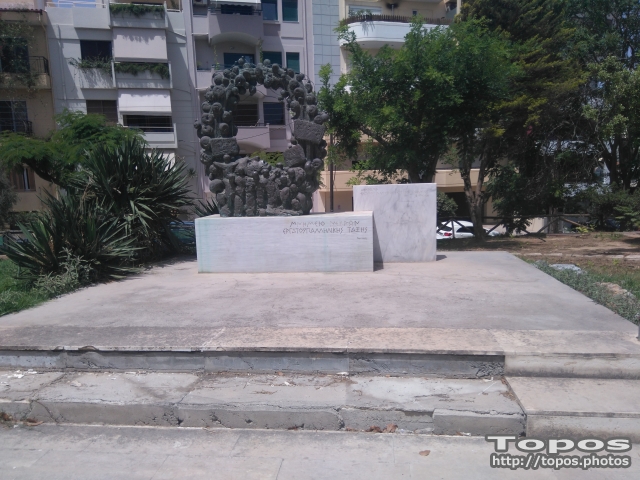


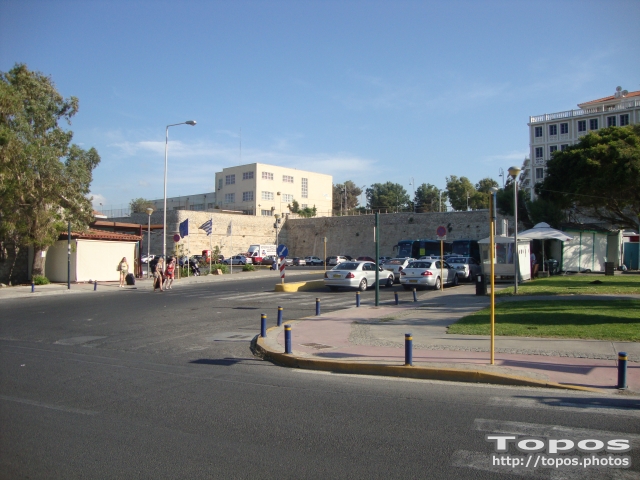
St. George gate is the gate that once connected the Venetian town of Chandaka to eastern Crete. The gate is located to the east of Eleftherias Square just below the statue of Eleftherios Venizelos.
According to an inscription, the gate is built in 1565. Its name comes from a relief decorative representation of St. George, which is today exhibited in the historical museum of the city. The gate was formerly known as Lazareto, because it led to the homonymous sanctuary, and later as Maroulas gate leading to the homonymous district.
A 43 meter-long gallery begins through the gate, which can be visited and usually hosts exhibitions, which ends at the east of Eleftherias Square.
The Museum of the Battle of Crete and National Resistance (1941-1945) was founded by the Municipality of Heraklion in May 1994.




The room before you resembles a cistern. Its floor is lower than the surrounding area is reached by steps. The "Lustral Basin" was surrounded by columns and was lined with slabs of gypsum giving it a luxurious appearance. In its present form, the area has been completely reconstructed by Evans.
Areas with a similar arrangement have been found in other parts of Palace of Knossos, as well as at other palaces and in importance of Minoan buildings of the period (1700 - 1450 B.C.).
It is known how these places were used. However, from their construction it seems that they were used in purification ceremonies and therefore called these places "Lustral Basins".
Evans also believed that the Palace was a sacred place. That is why, in his opinion, the "Lustral Basins" in question was used to purify visitors going into the Palace via the neighboring North Entrance.




An open air passage linked the Central Court with the North Entrance. It was paved and sharply inclined towards the north.
The passage is narrow. Right and left were two raised colonnades known as "Bastions".
Arthur Evans reconstructed the "Bastion" on the west side. He also placed a copy of a restored relief fresco of a bull here. The wall painting may have formed part of a hunting scene.
The passage ends in a large hall with ten square pillars and two columns. The pillars and columns probably supported a large hall on the upper floor.
Evans suggested that, due to its position on the seaward side, it was here that the produce of seaborne trade would have been checked when it reached the Palace. It was therefore named the "Customs House".
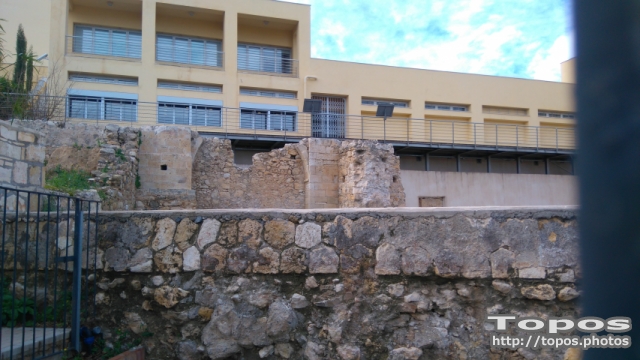
The south part and south facade of the Palace is very eroded. Today one can only see foundations on tiered levels. At the bottom, a tower-like projection is all that remains of the south entrance to the Palace. An ascending corridor led to the Central Court.
The section of the corridor closest to the Central Court is reconstructed. Evans put a copy of a relief wall painting here, of which only a few fragments were found. On these it was possible to make out a figure wearing jewellery in the shape of lilies. The reconstruction you see here is uncertain. In Evan's opinion, it represented the "Priest-King".
Other scholars think that it is prince, whilst others believe it depicts a female figure



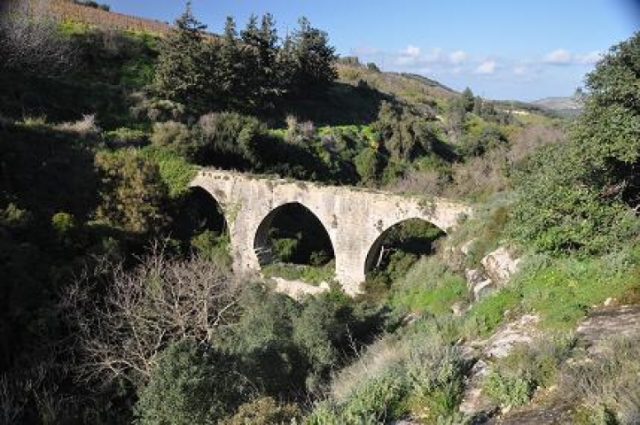

It is crossed by the torrent Kairatos (or Katsampas) that is going through Saint Eirini and Knossos and ends to the sea in the Katsampa area. The area of the gorge, which is also named Paradise, has been characterized as a place of particular natural beauty and has been included in the network Natura 2000.
The flora in the GorgeDiversity of flora species in the area is low because of shading from the dominant “platani” and “vatos” species. There are 120 species of plants present in the gorge. Forty are found in the watercourses of the rivers and the rest are in close distance. Endemic species are present only in the gorges (11 species) from which 2 are infrequent and 9 are common endemic species of Crete. The infrequent species are Campanula tubulosa that sprouts in Western Crete and Nepeta melissifolia that is an endemic of Crete and Milos and is found in small populations.An Important element of the gorge’s flora is the presence of an important population of “ftelia” tree Ulmus minor ssp. Canescens. This tree is found in small numbers in the Chania area and it is considered as imported. The existence of an important population in the Knosano gorge proves that this tree is indigenous of Crete, a remaining of a previous cold season, when glaciers existed in continental Europe.
The fauna in the GorgeTwo migratory species of birds that are met in the gorge are “mygochaftes” and “tsalapeteinoi”. Jackdaws and certain mountainous species like “galazokotsyfas” also exist. The majority of the remaining species are those that are found in bushy vegetation. Where swamps of fresh water and trees exist a great variety of small birds is found, as “spizes” and ladybirds. In addition, inside the gorge the water turtle and the amphibian green “frynos” and tree frog exist.




 Login with
Facebook
Login with
Facebook