



 Upload your photos for Pelekita Ancient Quarry and share them with us!
 Press here.


Prefecture: Lassithi
 Address:
Κάτω Ζάκρος
Address:
Κάτω Ζάκρος  Telephone:




Pelekita Ancient Quarry
Approximately half way along the path leading from Kato Zakros to Karoumes beach (geotrail 12) and near Pelekita cave, is the ancient quarry by the same name. We find it amidst compacted Pleistocene aeolianite sandstone, which were easily excavated as they are soft rocks due to their many pores. On the rocks in the area there are several traces of the excavation activity that took place in the past.
Places near Pelekita Ancient Quarry
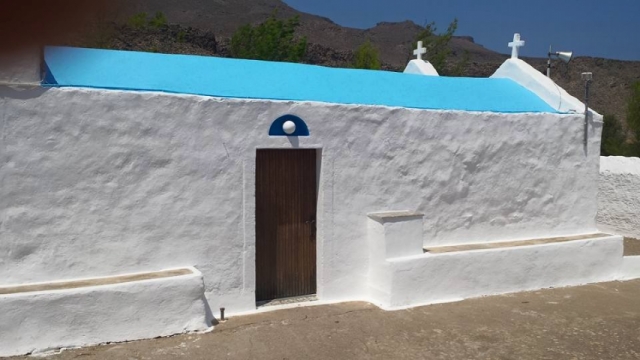


Traostalos is one of the highest mountains near the coast of south-east Crete and 14km far from Palekastro Village.Despite its only moderate height (515.4 m), however, the solid, isolated massif of Traostalos dominates the surrounding area, and its summit can be distinguished from afar, both from the sea and from inland (Pl. XIIa).
The highest point of the sanctuary commands an uninterrupted view over the entire east end of Crete, Kasos, Karpathos and the Dionysades islets to the north, and Kouphonisi to the south. It thus overlooks the sea route from the north Aegean to the east Mediterranean.From its summit, the sanctuary enjoys visual contact with almost all the other peaks in the area on which have been found cult deposits, or buildings that served cult purposes. These are, from south to north, the sanctuaries at Ambelos, Korakomouri, Mare, Ziros (Playia),Viglos, Modi, Kalamaki, and Petsophas (Pl. XIIb-XIII). In Minoan times, the historical landscape was bounded by the palace and town of Zakros to the south and the town of Palekastro to the north.Habitation in the immediate environment of the sanctuary takes the form of a scattering of isolated buildings, of which the following are the most important: In 1964, Kostis Davaras partially excavated a Minoan villa at the modern village of Azokeramos on the lower north-western slopes of Traostalos.In the western to south-western foothills stands the megalithic building at Skaphi5 and what is probably a guard-house at Polla Kladia. The densely occupied Chochlakies valley, with a guard-house, probable villa, and settlement, is in the north-western foothills.Mount Traostalos has a distinctive articulation with a series of bare plateaux. This reflects the stepped morphology of the east and south-east coasts of Crete. The bay of Karoumes, the only anchorage on the steep coast, is formed by the north to north-east face of Traostalos, which is known characteristically as ‘Adiavatos,’ or ‘Impassable.’ Habitation in the bay of Karoumes covers a long interval from the Neolithic period to Roman times. The Minoan period is represented by three megalithic buildings and an extensive series of walls and enclosures that change and organise the natural form of the hills.Finally, the coastline between the bay of Karoumes and that of Zakros is of great interest, not only for the important Neolithic occupation of the cave of Pelekita, but also for the systematic quarrying of limestone and poros in Minoan times. There were large quarries atPelekita and Papa i Limnes, and provision was made for transporting the blocks to the palace at Zakros.ApproachesThe summit can be approached by two routes. The first is a built road, now called ‘Skala tou Ayiou Antoniou’12 by the locals. This road, which runs roughly south-north, crosses the western foothills of Traostalos and links Kato Zakros with Palekastro. The second route is apath starting from the village of Azokeramos.The ascent to the plateau on the summit is easiest from the north and north-west, where the contours of the rocky terrain create a series of natural stretches of road, reinforced in places by steps and makeshift walls.Although the line of this ascent has been established, no stretch of road has been discovered that has the quality of construction of the road that led from Anemospilia to the sanctuary on Juktas.
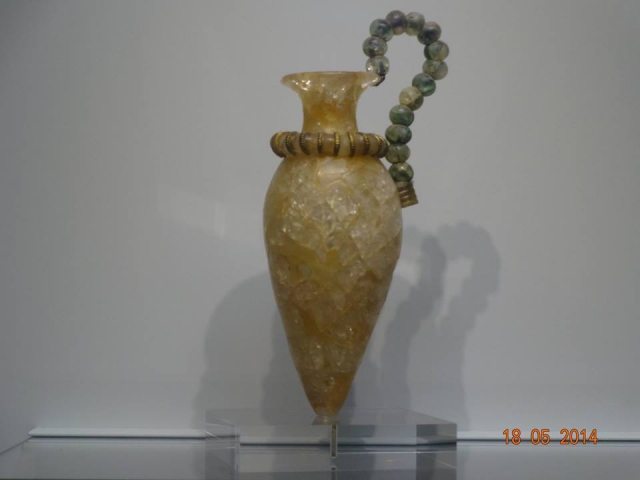
The Palace of Kato Zakros is located 26 kms south of Palekastro. Its position shelters it from the dangerously strong north winds that pass Cape Sidero on the north-east tip of Crete.
It was the last of the major palaces to be discovered and is smaller than the other three at Knossos, Malia and Phaistos. The original excavations were begun by D.G. Howarth of the British School of Archaeology in Athens, and 12 houses in the town surrounding the Palace, whose existence remained unknown, were unearthed before the excavation was abandoned.
Nikolaos Platon resumed the excavation in 1961 and was able to unearth a palace which had not been looted at the time of its destruction. The excavations have continued until the present day. The excavation represents one of the most important for Minoan archaeology since the Second World War, and the lateness of its discovery allowed it to be excavated using more modern and more scientific methods than those adopted in the excavation of the other Palaces some 60 years earlier.
Kato Zakros Minoan Palace Kato Zakros Minoan Palace Kato Zakros Minoan Palace
The Palace of Zakros probably acted as the Minoan gateway to the east and this view is supported by various movable finds on the site which had come from the Middle East. Like the other palaces, Zakros was rebuilt after the earthquake destruction of the old palaces. The second palace was built around 1600 BC and finally destroyed around 1450 BC, along with other centres of Minoan civilisation in Crete.
Fortunately many artefacts were left in situ, probably due to the suddenness of the destruction. The palace covered 8,000 square metres, contained 150 rooms and had a Central Court measuring about 30 metres by 12 metres, smaller than that of Knossos.


Karoumes Beach (or Chohlakies Beach): At the village Chohlakies begins a magnificent accessible Karoumes gorge that ends after 1,5 hour walking to the pure and scenic bay of Karoumes. Chochlakies village is located between Palekastro and Zakros.
You can approach this completely lonely beach only through this gorge! Karoumes is the most remote beach in Eastern Crete !! Chohlakies is located 8 km south from Palekastro, on the way to Zakros.


Located north east of the small village of Kato Zakros between Karoumes and Kato Zakros beach in Sitia region.
The cave can be reached by traveling one hour from Kato Zakros, or from the beach of the village by using mechanized boats and then making an ascent.
The height at the entrance is 105m. The whole area is commonly known as Pelekita, which name is derived from the quarry, which is below the cave, close to the sea, from which stones have been extracted.
The other name "Sykias Spilios" was given to the cave because of the location of a large fig tree at the entrance. Under the cave one can see the sea as if viewing it from a plane.
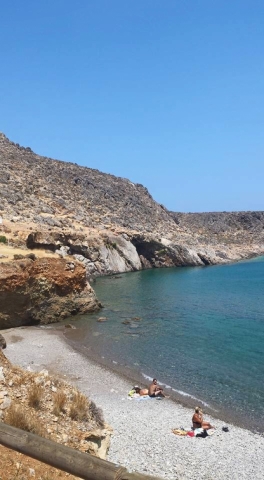

Karoumes Beach (or Chohlakies Beach): At the village Chohlakies begins a magnificent accessible Karoumes gorge that ends after 1,5 hour walking to the pure and scenic bay of Karoumes. Chochlakies village is located between Palekastro and Zakros.
You can approach this completely lonely beach only through this gorge! Karoumes is the most remote beach in Eastern Crete !! Chohlakies is located 8 km south from Palekastro, on the way to Zakros.

Coral rooms in coastal resort Kato Zakros for your holidays - vacation. Whether you sit on the terrace or gaze at the view of the beach and sea below from your room, Coral Rooms provide the real sea-side experience with comfortable and well cared for surroundings. Situated immediately below Athena Rooms, private bathrooms. East Crete Kato Zakros!!


These are isolated limestone boulders that have come loose and rolled along part of the Kato Zakros – Karoumbes footpath. The boulders are spread out and impressive, and create a theatrical landsnappee, as though they are alive. They are also ideal for climbing (bouldering).


 Login with
Facebook
Login with
Facebook