



 Upload your photos for Dodeka Apostoloi and share them with us!
 Press here.


Prefecture: Lassithi
 Address:
 Telephone:




Dodeka Apostoloi
The Monastery of Holy Apostles is located at Karkasa just 400m southwest from Sotiras Monastery, 4km west of Anatoli village and 16km far from Ierapetra Town, on the southern slopes of Lasithi Mountains.
This was once a small monastic complex which supervised the neighboring monasteries of Jesus Christ the Saviour, and Virgin Mary ‘Panagia Vagionea’. The monastery of Karkasa (or Karkasia) is well-known from archival sources of the 15th century and must have included all these three small monasteries. In the late 14th century, the scholar monk Nilos Damilas lived in the monastery. He was known for his action against the pro-Western theologians of the era and left important writings.
Only ruins survive from the cells of the original monastery. The catholicon is a single-nave barrel-vaulted church of 10.00 x 5.40 m, with two transverse reinforcing arches. The church is adorned on all its internal surfaces with frescoes, which constitute a comprehensive iconographic whole, including a total of 31 scenes.
Apart from the wider Christological cycle on the northern wall (22 out of its 26 scenes survive), above the zone of saints depicted in full body, we can see a cycle of the martyrdom of the Apostles, to whom the church is dedicated. The preservation of the iconographic decoration is unsatisfactory, however, on the basis of a 1429 incision, it has been dated to the 15th century (Maderakis 1988, 59). Two important icons which were in its altar-screen with distinct elements of Constantinople-styled art dated to around 1400 are nowadays kept at the Church of All Saints in the village of Anatoli.
The monastery itself is currently inactive and belongs to the parish of Anatoli.
Places near Dodeka Apostoloi
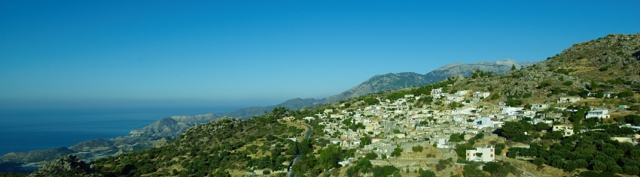

Village of the rising sun as the name implies. Old, historic, traditional village 17 KM Northwest of ierapetra, at an altitude of 600 m of homes visible from, is nested in the mountain stronghold of the East.
The 70s most of the inhabitants of the East went to Cabo and dealing with greenhouse crops. Founded along with residents of other villages settlements Spout, New East, Ammoydares. The small picturesque village of Monks who, according to tradition, it was built by a Turkish Agha belongs to the East. Referred from the Venetian era. The 1583 along with the Monks had 666 inhabitants. In 1951 with 897 in 2001 along with the New East 1235 inhabitants. There is a ruined Venetian feudal Lord's tower north of the village.
Many ecclesiastical monuments, Monasteries, great art Byzantine icons. The old traditional village of East remained unchanged in time, with its stone houses, narrow streets, the old Down faucet.


In rocky hill Stavromenos an important peak sanctuary was established during the Minoan era. The superb location allows the supervisory control both northern Cretan and the South to the Libyan Sea, while in the immediate environment also stands the Minoan Gaidourofas building. As indicated by various offerings found in the area, the worship in this position continued until Roman times.
During the Middle Minoan period (2100-1700 BC) was particularly endearing the exercise of public worshipness in the countryside and particularly in top peaks of mountains. Here was used for inhabitants to gather to the surrounding villages in order to lay their votive like clay figurines of men, women and animals.



The Monastery of Holy Apostles is located at Karkasa just 400m southwest from Sotiras Monastery, 4km west of Anatoli village and 16km far from Ierapetra Town, on the southern slopes of Lasithi Mountains.
This was once a small monastic complex which supervised the neighboring monasteries of Jesus Christ the Saviour, and Virgin Mary ‘Panagia Vagionea’. The monastery of Karkasa (or Karkasia) is well-known from archival sources of the 15th century and must have included all these three small monasteries. In the late 14th century, the scholar monk Nilos Damilas lived in the monastery. He was known for his action against the pro-Western theologians of the era and left important writings.
Only ruins survive from the cells of the original monastery. The catholicon is a single-nave barrel-vaulted church of 10.00 x 5.40 m, with two transverse reinforcing arches. The church is adorned on all its internal surfaces with frescoes, which constitute a comprehensive iconographic whole, including a total of 31 scenes.
Apart from the wider Christological cycle on the northern wall (22 out of its 26 scenes survive), above the zone of saints depicted in full body, we can see a cycle of the martyrdom of the Apostles, to whom the church is dedicated. The preservation of the iconographic decoration is unsatisfactory, however, on the basis of a 1429 incision, it has been dated to the 15th century (Maderakis 1988, 59). Two important icons which were in its altar-screen with distinct elements of Constantinople-styled art dated to around 1400 are nowadays kept at the Church of All Saints in the village of Anatoli.
The monastery itself is currently inactive and belongs to the parish of Anatoli.


 Login with
Facebook
Login with
Facebook